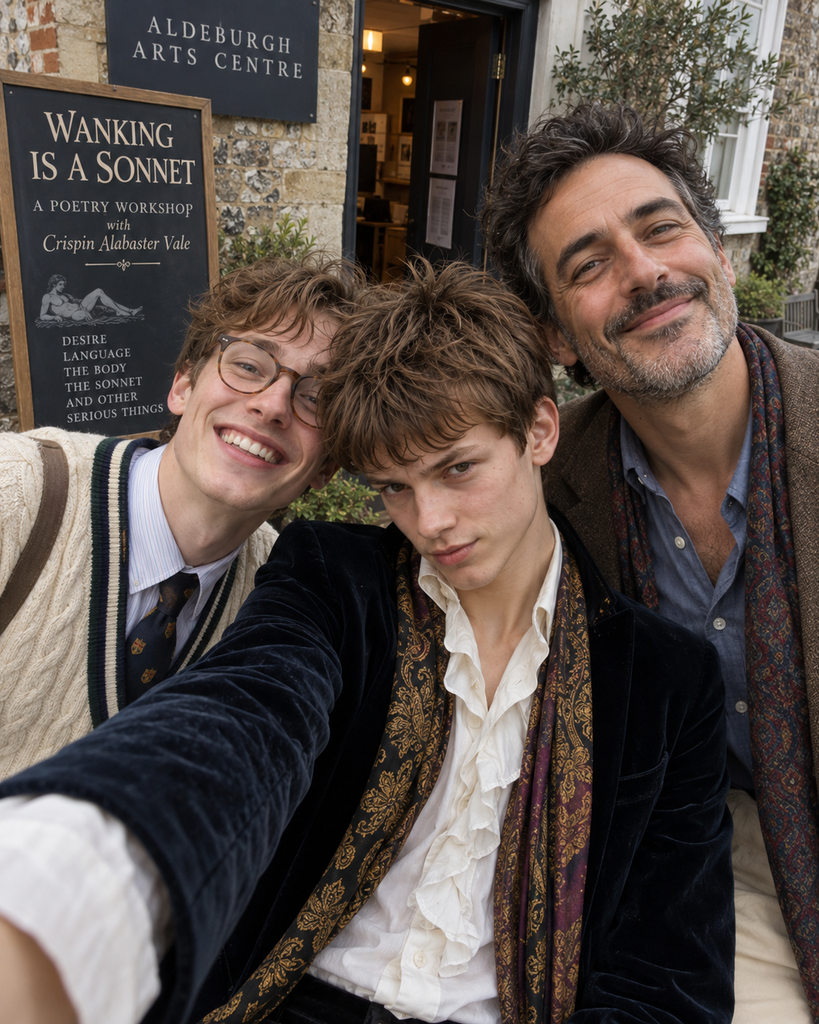
Two Days in Suffolk with Crispin Alabaster Vale, Gay Teenage Poet Laureate of the Known Universe
By Professor Mateo Luis Álvarez Professor of English and Comparative Poetics University of California, Santa Cruz Director, Center for Unauthorized Poetic Practices
An account of literary instruction, adolescent authority, the management of embarrassment, and an unexpected friendship between two men who should probably have known better.
I. The Poet Has Provided Biscuits
On a Saturday morning in October, I found myself standing outside the Aldeburgh Literary Arts Centre, contemplating a poster bearing the words:
WANKING IS A SONNET
A Two-Day Poetry Workshop with Crispin Alabaster Vale
Gay Teenage Poet Laureate of the Known Universe
Beneath the title, in smaller letters, appeared the reassuring information:
No previous experience necessary.
It was not immediately clear which activity this referred to.
I had travelled from California to observe the workshop, partly because my research concerns the relationship between queer embodiment and poetic form, and partly because I had become professionally interested in a fourteen-year-old English boy who appeared to be conducting a sustained campaign against the entire history of literary respectability.
Vale had agreed to my attendance on the condition that I refrain from “doing academic bullshit at people”.
I had replied that I would endeavour to exercise restraint.
He had written back:
Good. Bring biscuits.
The arts centre occupied a converted Victorian school building, a fact that seemed almost too conveniently symbolic for a workshop taught by a poet whose earliest work had compared compulsory education to state-sponsored soul destruction.
Inside, a handwritten sign directed participants upstairs.
Someone had added beneath it:
THE CURTAINS KNOW.
I suspected Vale.
I was wrong.
This would become a theme of the weekend.
There were twelve participants, not including myself, ranging in age from seventeen to sixty-eight. They represented a rather pleasing cross-section of British literary aspiration.
There was Judith, a retired English teacher from Norwich, who had been writing poetry privately for forty years and possessed the sort of quiet authority that made me instinctively want to check my quotations.
There was Martin, a divorced accountant from Ipswich, whose registration form apparently listed his principal creative interest as “finding a way to stop being an accountant internally”.
There was Zahra, a twenty-six-year-old performance poet from London, who wore silver boots and had already published two pamphlets.
There were two sixth-form students, an NHS physiotherapist, an illustrator, a librarian, a woman who described herself as “poetry-adjacent”, and three people whose principal qualifications appeared to be curiosity and disposable income.
And then there was Nathaniel Pembroke-Hughes.
I recognised his name from an article he had sent me several weeks earlier.
But They Were Cunted in Their Turn: Analysing the Errata to Find the Hidden Vale.
It was a remarkable piece of undergraduate scholarship.
Its central argument was intelligent, its manuscript research promising, and its author’s enthusiasm sufficient to power a medium-sized municipal railway.
He had written approximately six thousand words about a deleted line of Philip Larkin parody.
I had described the article as interesting.
Nathaniel had subsequently sent me three emails thanking me for that description.
He was sitting in the second row, wearing a dark green cardigan over a white shirt, with a notebook balanced on his knees.
When he saw me, his entire posture changed.
“Professor Álvarez?”
“Nathaniel?”
“Oh my God.”
He stood up so quickly that his notebook fell.
“I didn’t know you were coming.”
“Neither did I, until quite recently.”
“I’m Nathaniel Pembroke-Hughes.”
“Yes. The Larkin manuscripts.”
He put a hand against his chest.
“You remember?”
“Of course. You wrote a very interesting paper.”
The young man made a noise resembling a kettle discovering its purpose.
“I can’t believe this.”
He was twenty-one, tall, fair-haired, slightly awkward and possessed of an intensely expressive face. His enthusiasm seemed to travel through his entire body before arriving at his mouth.
“I’ve been reading your work since my first year.”
“That’s very kind.”
“Bedrooms Without Witnesses completely changed how I understood lyric privacy.”
“Thank you.”
“And your article about solitary subjectivity in postwar poetry—”
“You’re very generous.”
“And I read your dissertation.”
I paused.
“My dissertation?”
“Yes.”
“One Hand Clapping?”
He nodded fervently.
“I thought the chapter on erotic solitude was extraordinary.”
I regarded him.
There are moments in academic life when one encounters an exceptionally promising young scholar.
There are other moments when one encounters someone who has voluntarily read one’s doctoral dissertation about masturbation.
The distinction is not always clear.
“Nathaniel,” I said, “I think we should probably have coffee.”
He looked delighted.
“Really?”
“At some point.”
“Absolutely.”
From the front of the room came a voice.
“Jesus Christ, Mateo, don’t encourage him.”
Crispin Alabaster Vale had arrived.
He was carrying a packet of chocolate digestives, a canvas bag and a small, furious-looking notebook.
He wore black jeans, battered Converse and an oversized floral shirt. His dark hair looked as though he had cut it himself during an argument.
He was fourteen.
This fact was impossible to ignore and, as the weekend progressed, increasingly difficult to reconcile with the person speaking.
“Morning, everyone,” he announced.
He dumped the bag onto the desk.
“Welcome to Wanking Is a Sonnet. If you’ve come here expecting therapy, I’m afraid you’ve booked the wrong humiliation.”
He opened the biscuits.
“If you’ve come here expecting poetry, things may improve.”
Then he looked directly at Nathaniel.
“And if you’ve come here to ask me about the deleted Larkin line, I will throw you into the North Sea.”
Nathaniel nodded enthusiastically.
“Understood.”
Crispin looked at me.
“See what I mean?”
I was beginning to.
II. The Body Is Not a Metaphor Until You Make It One
The first session began with an unexpected proposition.
“Poetry,” Crispin told us, “is not about feelings.”
Judith raised an eyebrow.
Zahra folded her arms.
Nathaniel immediately wrote this down.
“Obviously,” Crispin continued, “poetry is frequently caused by feelings. That’s different. Feelings are what you have before you’ve done any work.”
He wrote on the whiteboard:
I AM SAD.
“This is not a poem.”
Martin raised his hand.
“Couldn’t it be?”
“Yes. But then you’d need to do something interesting with the fact that it’s not interesting.”
He wrote beneath it:
MY FATHER IS A CAR PARK.
“Now we’re getting somewhere.”
A small murmur of recognition passed through the room.
Crispin regarded us gravely.
“Please don’t applaud. It’s embarrassing.”
He explained that poetry begins not with the emotion itself but with the pressure exerted upon language when the poet attempts to make that emotion perceptible to someone else.
“You can’t give somebody your sadness,” he said. “You can give them a thing that makes them feel something related to it.”
He pointed to the second sentence.
“My dad isn’t actually a car park. He’s an insurance manager. Which is arguably worse, but less interesting poetically.”
Several participants laughed.
“The important thing is that the image does something. It makes him concrete. It makes him a place where movement stops. It makes him a system of controlled access.”
I was impressed.
This was a surprisingly clear explanation of image construction from someone who had publicly described literary criticism as “people putting trousers on words”.
Nathaniel raised his hand.
“Yes, Nathaniel.”
“Would you say that the car park functions as a municipal displacement of paternal affect?”
Crispin considered this.
“No.”
Nathaniel looked crushed.
“I’d say Dad is emotionally unavailable and car parks are depressing.”
“But the infrastructural analogy—”
“Is funny.”
“Of course.”
“And also true.”
“Yes.”
“And that’s enough.”
Nathaniel wrote furiously.
Crispin sighed.
“You’re going to turn that into twelve thousand words, aren’t you?”
“Probably.”
“At least you’re honest.”
The first exercise was simple.
We were instructed to write down an emotion we had experienced recently, then identify three ordinary objects associated with it.
We were forbidden to name the emotion in the resulting poem.
“Make the object do the work,” Crispin said.
Judith wrote about her late husband’s gardening gloves.
Martin wrote about an unused second toothbrush.
Zahra wrote about a cracked phone screen.
Nathaniel wrote about a cardigan.
Crispin discovered this during the first reading.
“Of course you did.”
Nathaniel flushed.
“I thought I might explore clothing as a vehicle of institutional and personal contradiction.”
“Read it.”
Nathaniel cleared his throat.
My cardigan hangs between belonging and the academy, its buttons closed against the weather of another man’s genius.
There was a silence.
Crispin stared at him.
“Nathaniel.”
“Yes?”
“Am I the other man?”
Nathaniel looked at his shoes.
“Possibly.”
“Christ.”
He considered the poem.
“Actually, the buttons are good.”
Nathaniel looked up.
“Really?”
“Yes. But stop explaining what the cardigan means. Let it be a cardigan.”
Nathaniel nodded.
“And for God’s sake don’t call me a genius in your poetry. It makes me sound dead.”
I watched Nathaniel write this down.
Then, beneath it, he wrote:
The buttons are good.
I suspected the phrase would remain important to him for some time.
The garden gloves
Judith’s poem was considerably better.
She described a pair of old green gardening gloves, stiff with dried soil, hanging from a nail in the shed.
She never mentioned her husband.
She never mentioned death.
The poem ended with the observation that the right glove had fallen to the floor but the left remained hanging.
When she finished, nobody spoke.
Crispin looked down at his notebook.
Then he said, very quietly:
“That’s good.”
Judith smiled.
“Thank you.”
“No, I mean really good.”
He looked around the room.
“See? That’s what I mean. She hasn’t told us what to feel. She’s shown us two gloves.”
He paused.
“And now I want to fucking cry.”
Judith laughed.
Crispin did not.
For perhaps fifteen seconds, the workshop became entirely serious.
Then Martin asked whether he could read his toothbrush poem.
Crispin nodded.
Martin began:
The toothbrush stands alone like a penis at a funeral—
“No,” Crispin said.
Martin stopped.
“No?”
“Absolutely not.”
“But you said we should use physical imagery.”
“I said use imagery. I didn’t say conscript every object into genital service.”
From the second row, Nathaniel made a small noise.
Crispin turned.
“What?”
“Nothing.”
“Nathaniel.”
“I was just thinking that the title of the workshop might—”
“The title is marketing.”
This produced the first great laugh of the weekend.
III. The Sonnet Is a Prison with Excellent Acoustics
The second session concerned form.
Crispin began by drawing fourteen horizontal lines on the board.
“This,” he announced, “is a sonnet.”
He waited.
“Fourteen lines. Usually some kind of argument, often a turn, sometimes a rhyme scheme. Shakespeare used them to tell people how gorgeous they were. Donne used them to shout at God. Keats used them to get upset about urns.”
He wrote:
STRUCTURE IS NOT THE ENEMY.
“Structure is useful because most feelings are boring when left unattended.”
Judith nodded.
Nathaniel wrote the sentence down.
I made a note myself.
Crispin went on to distinguish between the Petrarchan and Shakespearean sonnet, explaining the octave and sestet, the three quatrains and closing couplet, the role of the volta, and the ways rhyme could create expectations that a poet might satisfy or deliberately frustrate.
His command of the material was impressive.
His terminology was occasionally eccentric.
He described the volta as “the bit where the poem stops lying to itself”.
He referred to iambic pentameter as “the heartbeat of a man who has read too much Shakespeare”.
And he explained enjambment by saying:
“Sometimes a line ends because the thought has finished. Sometimes it ends because you want the reader to fall down a little staircase.”
I wrote that down too.
Then he returned to the workshop title.
“Right. Wanking.”
Several participants shifted in their chairs.
Martin looked delighted.
Judith opened another page of her notebook.
Nathaniel appeared to be experiencing an important spiritual occasion.
“Why is wanking a sonnet?” Crispin asked.
Nobody volunteered.
He pointed to the board.
“Because it’s private, repetitive, occasionally embarrassing, generally structured around anticipation, and often ends with a disappointing couplet.”
The room exploded.
Even Judith laughed so hard she removed her glasses.
Crispin waited with the expression of a lecturer whose students had finally discovered the obvious.
“Also,” he continued, “both involve a lot of people pretending they don’t know what they’re doing.”
I was laughing.
Nathaniel was practically incandescent.
“But seriously,” Crispin said, “the point is that the sonnet gives you a structure for something that feels chaotic. Desire is chaotic. Shame is chaotic. Grief is chaotic. You put it inside fourteen lines and suddenly you have to make decisions.”
He wrote:
THE FORM DOES NOT SOLVE THE FEELING.
Beneath it:
IT MAKES YOU ACCOUNTABLE FOR THE WORDS.
That sentence changed the atmosphere.
Crispin turned back towards us.
“If you’re going to write about something embarrassing, you can either hide behind the embarrassment or make something out of it. Poetry makes you choose.”
Nathaniel raised his hand.
“Yes?”
“Would you say that the sonnet’s formal closure creates a provisional resolution to an otherwise unresolved embodied experience?”
Crispin thought about it.
“Yes.”
Nathaniel froze.
Crispin added:
“That’s actually quite good.”
I thought Nathaniel might ascend.
“Thank you,” he whispered.
“Don’t make a thing of it.”
“Of course.”
“You’re making a thing of it.”
“I’m trying not to.”
“Try harder.”
The sonnet exercise
We were instructed to write fourteen lines about something we found difficult to discuss.
It need not be sexual.
Indeed, Crispin advised that the room would probably benefit if it wasn’t.
“Some of you are looking far too eager.”
Martin put down his pen.
We had forty minutes.
I wrote about growing older.
Judith wrote about resentment towards her sister.
Zahra wrote about the humiliation of being publicly misunderstood.
Nathaniel wrote about literary admiration.
Again.
He produced an ambitious Petrarchan sonnet in which the octave described a young scholar approaching an intellectual monument and the sestet considered the collapse of interpretive distance.
It was technically competent.
It was also almost unbearably deferential.
Crispin read it twice.
Then he said:
“Nathaniel, you’re allowed to dislike me.”
Nathaniel blinked.
“I don’t dislike you.”
“I know. That’s the problem.”
“Sorry.”
“Stop apologising.”
“Sorry.”
Crispin closed his eyes.
I intervened.
“Nathaniel, perhaps what Crispin means is that admiration can become a limitation if it prevents you from making your own choices.”
“Exactly,” Crispin said.
Nathaniel looked between us.
“But I am making choices.”
“Yes,” Crispin replied. “You’re choosing to write a poem about how clever I am.”
There was a brief silence.
Then Nathaniel laughed.
To his credit, he laughed properly.
“Fair.”
“Write about something you’re angry about,” Crispin suggested.
Nathaniel considered.
“Academic gatekeeping?”
“No.”
“Homophobia?”
“Too general.”
“Funding structures in higher education?”
Crispin stared at him.
“You’re twenty-one. Surely something’s actually happened to you.”
Nathaniel looked down.
After a moment, he said:
“My first boyfriend told me I was exhausting.”
The room became quiet.
Crispin tilted his head.
“Was he right?”
Nathaniel laughed uncertainly.
“Probably.”
“Did it hurt?”
“Yes.”
“Then write that.”
It was the first time I saw Crispin make a deliberate decision not to be funny.
He could have turned the exchange into a joke.
He didn’t.
For the remaining twenty minutes, Nathaniel worked without looking up.
I did not read what he wrote.
I would hear it the following day.
IV. The Café of Insufficient Restraint
At six-thirty that evening, ten of us gathered at a coffee shop near the seafront.
The premises had the sort of polished wooden tables and mismatched chairs that announce an establishment’s determination to charge seven pounds for something involving oats.
Crispin arrived late.
He was accompanied by Scab and Antigone, his two whippets, who entered the café with the air of aristocrats inspecting a provincial estate.
Scab was dark, slender and apparently suspicious of furniture.
Antigone was pale and immediately identified the most comfortable chair.
Crispin ordered an enormous hot chocolate with whipped cream.
Nathaniel ordered an oat flat white.
I ordered espresso.
Martin ordered a cappuccino and, for reasons nobody ever established, a sausage roll.
The conversation began with poetry and quickly descended into the kind of cheerful intellectual disorder that makes conferences worth attending.
Judith told us about teaching Larkin to sixth-formers in the 1980s.
Zahra argued that spoken-word poetry had been unfairly dismissed by university departments.
Martin confessed that he had once submitted a poem to a competition under a false name because he did not want his colleagues to know he wrote.
Crispin wanted to know the pseudonym.
Martin hesitated.
“Peter Tempest.”
There was a silence.
Crispin looked at him.
“Peter Tempest?”
“Yes.”
“That’s magnificent.”
Martin blushed.
“Really?”
“Absolutely. It sounds like a weather presenter who’s murdered his wife.”
The table erupted.
Martin laughed hardest of all.
Then Crispin asked him why he’d stopped submitting poems.
Martin shrugged.
“Divorce. Work. Life.”
“Write more.”
“I might.”
“Do.”
It was not advice elaborated with psychological theory.
It was a simple imperative.
And I noticed Martin nod as though someone had given him permission.
Negative capability and hot chocolate
At some point, Nathaniel and I began discussing Keats.
Nathaniel was interested in the relationship between negative capability and Vale’s apparent refusal to settle interpretive ambiguity.
I suggested that Crispin’s poetry often moved in the opposite direction: rather than tolerating uncertainty, he tended to prosecute it.
Nathaniel laughed.
“That’s true. But don’t you think the curtains—”
“No,” Crispin said from across the table.
We looked at him.
“No what?” I asked.
“No more curtains.”
“We weren’t necessarily—”
“You were.”
Nathaniel smiled.
“I was only going to suggest—”
“That they’re an expression of epistemological indeterminacy?”
Nathaniel looked startled.
“Actually, yes.”
“Christ.”
Crispin took a large mouthful of hot chocolate.
I asked him whether he believed in negative capability.
“Obviously.”
“How would you define it?”
“Being capable of being negative.”
Nathaniel began to speak.
Crispin held up a hand.
“I know what Keats meant.”
“Of course,” Nathaniel said.
“I just think he could’ve been clearer.”
Then, with no change of tone, Crispin offered a remarkably perceptive account of ambiguity in lyric poetry.
“Sometimes you don’t want to tell the reader what something means because then you’ve finished the poem for them. If you leave the right kind of space, they have to put themselves into it.”
I nodded.
“That’s very well put.”
“Obviously.”
“But wouldn’t you agree that this requires considerable confidence in the reader?”
“No. It requires confidence in the poem.”
I considered that.
Nathaniel was writing on a napkin.
Crispin noticed.
“Stop it.”
“Sorry.”
“You’re at dinner.”
“I know.”
“With people.”
“Yes.”
“Try being one.”
Nathaniel put down his pen.
Crispin smiled.
“Better.”
Then he added:
“Also Keats would’ve loved a wank.”
Judith nearly choked on her tea.
The problem of admiration
Later, while Crispin was outside with the dogs and several participants had gone to the counter, Nathaniel and I found ourselves alone at one end of the table.
“He’s extraordinary, isn’t he?” Nathaniel said.
“Yes. Though perhaps not always in the way he imagines.”
Nathaniel laughed.
“I know I get carried away.”
“A little.”
“I’m trying not to.”
“Don’t try too hard.”
He looked surprised.
“Really?”
“Enthusiasm is not a defect, Nathaniel.”
He considered this.
“My supervisor might disagree.”
“Your supervisor is probably trying to prevent you from making claims you can’t defend.”
“She says I confuse significance with excitement.”
“That’s a useful distinction.”
“I know.”
“But excitement can lead you towards significance. You simply have to learn when to stop.”
Nathaniel smiled.
“That’s the hard part.”
“Yes.”
He looked across the café.
Crispin was standing beside the window, explaining something to Zahra while Antigone attempted to investigate a pastry bag.
“You know,” Nathaniel said, “I sometimes worry that people think I’m an idiot.”
“Why?”
“Because I get so excited. Because I say stupid things when I meet people I admire.”
“Such as?”
“Well, this morning I nearly told you that your dissertation changed my life.”
“Did it?”
He looked embarrassed.
“Not exactly.”
I laughed.
“Then I’m glad you didn’t.”
“It made me feel less ridiculous about the things I wanted to study.”
That was different.
I put down my cup.
“That’s not a stupid thing to say.”
Nathaniel looked relieved.
He told me about Warwick, his dissertation, his ambitions and the difficulty of deciding whether he wanted to become an academic.
He loved literature.
He loved criticism.
He loved the strange process by which a small textual detail could open into a much larger argument.
But he was afraid that his enthusiasm made him unserious.
I told him that seriousness was not the same thing as solemnity.
He considered this carefully.
Then he asked whether he could quote me.
I looked at him.
“Nathaniel.”
“Sorry.”
We both laughed.
Crispin joins the conversation
Crispin returned carrying Antigone.
“What are you two talking about?”
“Academic careers,” I said.
“How depressing.”
He sat down.
Nathaniel asked whether Crispin had ever considered university.
“No.”
“Really?”
“Absolutely not.”
“But you love literature.”
“Yes.”
“And scholarship.”
“Occasionally.”
“And intellectual debate.”
“Only when I’m winning.”
I asked whether he would genuinely refuse higher education.
He considered.
“I might go to university if somebody paid me.”
“To attend?”
“To leave.”
Nathaniel laughed.
Crispin looked at him.
“You should become an academic.”
Nathaniel blinked.
“Really?”
“Yes.”
“Why?”
“You’re clever and you like reading things nobody else can be bothered reading.”
“That’s very kind.”
“Also you already dress like someone who’s disappointed a faculty committee.”
Nathaniel looked down at his cardigan.
“It’s vintage.”
“That makes it worse.”
I intervened.
“His manuscript research is genuinely excellent.”
Crispin nodded.
“Yes. Shame about the conclusions.”
Nathaniel smiled.
“Which conclusions?”
“Most of them.”
“Such as?”
“The curtains.”
“Again?”
“Always.”
Nathaniel sat forward.
“Actually, Crispin, I wanted to ask—”
“No.”
“But your distinction between accessories and informants—”
“No.”
“Because I think it fundamentally alters—”
Crispin turned towards me.
“Mateo, you can’t seriously take him back to California?”
“I’m afraid immigration would be complicated.”
“Tell them he’s an endangered species.”
Nathaniel laughed so hard that his coffee nearly spilled.
I found myself laughing too.
And somewhere in that ridiculous exchange, a peculiar affection settled over the table.
Crispin was no longer simply the subject of our research.
Nathaniel was no longer simply a young admirer.
And I was no longer simply an observer.
We were three people who loved poetry, each of us in ways that occasionally made us insufferable.
It was a pleasant evening.
V. Stealing from Dead People
Sunday began with rain.
Crispin arrived carrying a large book of English poetry and a packet of custard creams.
Scab and Antigone had remained at home.
Their absence was felt.
The morning session was entitled:
STEALING FROM DEAD PEOPLE: AN INTRODUCTION TO CANONICAL SQUATTING
Crispin began by placing the anthology on the desk.
“Right. Dead poets.”
He opened it.
“There’s a lot of them.”
He turned several pages.
“Most of them were men. Some were brilliant. Some were boring. Some wrote about flowers for much longer than flowers deserve.”
Judith objected mildly.
“Some flowers are very interesting.”
“Yes, Judith. But not all of them need a sonnet.”
He explained that parody could be a form of close reading.
“You can’t properly wreck something unless you understand how it’s put together.”
He drew a house on the board.
“This is a poem.”
Then he drew a stick figure entering the house.
“This is you.”
Then he drew a large arrow pointing towards the roof.
“This is the bit where you knock the chimney off.”
Nathaniel was smiling.
Crispin turned to him.
“Don’t you dare call this canonical squatting.”
“But—”
“I know what Belladonna calls it.”
“Her argument is actually—”
“I know.”
“—quite persuasive.”
“Yes. That’s why it’s annoying.”
The mechanics of parody
Crispin offered three principles.
First, identify what the original poem is doing.
Second, preserve enough of its structure for the reader to recognise the relationship.
Third, introduce material that creates friction with the original’s assumptions.
“If you just replace words with rude words,” he said, “you get a rude version of the poem.”
He paused.
“Which can be funny.”
Another pause.
“But usually not for very long.”
I thought of his early Larkin parodies.
Nathaniel looked at me.
We both knew what was coming.
Crispin turned to the board.
“And yes, Nathaniel, sometimes you delete a line because it’s too close to the original.”
Nathaniel straightened.
“Would that include—”
“Don’t.”
“But the—”
“Nathaniel.”
“But they were cunted in their turn?”
Crispin closed his eyes.
The room erupted.
Most participants were already familiar with Nathaniel’s paper, which had circulated among them the previous evening.
Martin had described it as “rather a lot about one word”.
Crispin looked at the ceiling.
“Yes. That line.”
Nathaniel was practically vibrating.
“Could you explain your decision?”
“I’ve explained it.”
“Perhaps for the other participants?”
Crispin considered.
Then, to my surprise, he agreed.
“Fine.”
He wrote the deleted line on the board.
BUT THEY WERE CUNTED IN THEIR TURN
There it stood.
Large.
Capitalised.
A small monument to editorial restraint.
“It’s too close to Larkin,” Crispin explained.
He underlined the opening three words.
“The structure’s identical. The idea’s identical. I’ve just changed the verb.”
He turned.
“That’s not enough.”
Nathaniel was nodding vigorously.
“So I got rid of it.”
He erased the line.
“End of.”
Nathaniel raised his hand.
“Yes?”
“Would you agree that the deletion constitutes a moment of pre-emptive counter-canonical self-interruption?”
Crispin looked at him.
“No.”
“But—”
“It constitutes me noticing that I’d written a shit line.”
I put a hand on Nathaniel’s arm.
“Leave it.”
“But Professor—”
“I know.”
Crispin watched us.
“You’re both fucking hopeless.”
The unexpected challenge
The exercise required participants to choose an established poem and transform it while retaining a recognisable formal relationship.
Judith rewrote Wordsworth’s daffodils as a poem about hospital waiting rooms.
Martin transformed a Shakespearean sonnet into an account of discovering that his accountant’s calculator had finally died.
Zahra adapted Donne into a sharp, angry poem about racial profiling at airport security.
Nathaniel chose Ozymandias.
Crispin sighed.
“Of course.”
But the result was surprisingly strong.
Nathaniel’s poem described a collapsed university department, its former head immortalised in a plaque nobody read.
He retained Shelley’s ruined monument but replaced the desert with a campus building converted into luxury student accommodation.
The poem ended:
Look on my works, ye scholars, and despair: the library’s a gym. The books aren’t there.
Crispin laughed.
“That’s good.”
Nathaniel looked delighted.
“Really?”
“Yes.”
“Thank you.”
“Don’t get hard.”
Then Crispin made a suggestion.
He thought the second line should be more grotesque.
Perhaps the books had been pulped.
Perhaps the gym should be more explicitly commercial.
Nathaniel considered.
Then he said:
“I don’t think so.”
Crispin looked up.
“What?”
“I think the banality is the point.”
The room became quiet.
Nathaniel swallowed.
“If I make it grotesque, I turn the ending into an outrage. But the existing line is deliberately flat. The institution hasn’t been destroyed by an enemy. It’s simply been repurposed.”
Crispin stared at him.
Nathaniel continued, gaining confidence.
“The horror isn’t that anyone hates literature. It’s that they don’t care enough about it to hate it.”
A silence followed.
I found myself smiling.
Crispin looked back at the poem.
Then he nodded.
“Yeah.”
Nathaniel blinked.
“Yeah?”
“You’re right.”
I have rarely witnessed a more complete interruption of someone’s internal systems.
Nathaniel opened his mouth.
Closed it.
Opened it again.
“Right.”
Crispin grinned.
“Don’t look so surprised.”
“I’m not.”
“You are.”
Nathaniel laughed.
“Sorry.”
“Stop apologising.”
“Sorry.”
“Jesus Christ.”
But the moment mattered.
For the first time all weekend, Nathaniel had disagreed with Crispin without immediately retreating into reverence.
And Crispin had accepted the criticism.
Neither had been diminished.
Both had become more interesting.
VI. How to Know When You’ve Written Something Shit
The final session concerned revision.
Crispin began with a sentence that deserves to be preserved.
“Your favourite line is probably the one you should delete.”
He looked around the room.
“Not always. But often enough to be annoying.”
He explained that writers become attached to lines for reasons that have little to do with their effectiveness.
Perhaps the line took a long time to write.
Perhaps it contains an image of which the author is particularly proud.
Perhaps it expresses something personally important.
None of these qualities guarantees that it improves the poem.
“The reader doesn’t know how long you spent on it,” Crispin said. “They don’t care. They only get the words.”
He wrote on the board:
THE POEM IS NOT YOUR DIARY.
Then beneath it:
EVEN IF IT STARTED AS ONE.
This was the clearest statement of his compositional philosophy I had heard.
It also confirmed the central thesis of Nathaniel’s manuscript research.
I looked towards him.
He was writing quickly, but with a different expression from the one I had seen the previous morning.
Less astonishment.
More concentration.
Crispin demonstrated revision using a deliberately poor poem about a toaster.
The first draft contained a comparison between burnt bread and disappointed love.
He removed it.
He replaced it with an image of two slices emerging from the machine at different times.
Then he removed the word lonely.
Then he changed the ending.
The result was unexpectedly effective.
Martin asked whether the poem was autobiographical.
Crispin said:
“It’s a fucking toaster, Martin.”
Then he considered.
“Actually, yes.”
The room laughed.
The second sonnets
We returned to the poems written the previous afternoon.
The task was to identify three lines that were doing too much explaining, remove them and revise the poem without losing its emotional centre.
Judith removed a declaration of resentment.
Zahra eliminated an image that competed with a stronger one.
Martin deleted the funeral penis.
This was widely considered progress.
Nathaniel had rewritten his sonnet entirely.
When his turn came, he looked nervous.
Crispin nodded.
“Go on.”
Nathaniel read.
It was about a former boyfriend who had described him as exhausting.
There were fourteen lines.
The rhyme was unobtrusive.
The opening described a restaurant table, two empty glasses and a man looking at his phone.
The poem did not initially reveal that a relationship was ending.
Only gradually did the reader understand.
In the sestet, Nathaniel described trying to stop himself from talking, believing that silence might make him easier to love.
The final couplet read:
I learnt to make my sentences less long. He left before I found out what was wrong.
There was silence.
It was not a perfect poem.
The metre faltered in places, and one of the internal images was overworked.
But it had something.
It had Nathaniel.
Not the student of Vale, not the admirer of Álvarez, not the enthusiastic young scholar desperate to prove himself.
Just a twenty-one-year-old man who had once believed that making himself smaller might persuade someone to stay.
Crispin looked at him.
“That’s much better.”
Nathaniel nodded.
“Thank you.”
“The first line of the couplet’s a bit obvious.”
“I thought so.”
“And the second might be stronger without out.”
Nathaniel considered.
“Found what was wrong?”
“Maybe.”
He thought again.
“Actually, leave it. The rhythm’s better.”
Nathaniel smiled.
Crispin continued:
“But the thing about making your sentences shorter? That’s good. Keep that.”
“I will.”
“And don’t do it in real life.”
Nathaniel looked startled.
Crispin shrugged.
“Someone who likes you will want you to talk.”
It was an extraordinary sentence.
Not because it was especially original.
Not because it demonstrated theoretical sophistication.
But because it was spoken with complete simplicity by a boy who had spent most of the weekend converting human relationships into municipal catastrophes.
Nathaniel looked down at his notebook.
I watched him absorb the remark.
Then Crispin ruined the moment.
“Although maybe not quite so much about the fucking notebooks.”
Everyone laughed.
Nathaniel laughed too.
But I noticed that he did not cross anything out.
VII. The Professor and the Student
The workshop ended shortly after four.
Participants exchanged addresses, took photographs and bought copies of Milk Teeth in the Lawnmower.
Crispin signed books with the expression of someone performing a public service under protest.
Judith thanked him for the weekend.
He thanked her for the gloves poem.
Martin asked whether Crispin genuinely thought he should continue writing.
“Yes,” Crispin said.
“Even at my age?”
“Especially at your age. You’ve got more material.”
Martin laughed.
Zahra promised to send him a recording of a new performance piece.
Crispin asked her to do so.
Nathaniel waited until everyone else had finished.
Then he approached with his copy of the collection.
Crispin looked up.
“You already have a signed copy.”
“I know.”
“So?”
“I wondered whether you might sign the workshop booklet.”
Crispin held out his hand.
Nathaniel passed it over.
Crispin wrote something.
Then he returned it.
Nathaniel read the inscription.
He laughed.
I asked what it said.
He showed me.
To Nathaniel. You were right about the gym. Don’t tell anyone.
Crispin.
I smiled.
Nathaniel looked at the inscription for a long time.
Then he carefully put the booklet into his bag.
A walk towards the station
Nathaniel and I walked together towards the railway station.
The rain had stopped.
The Suffolk sky had opened into a pale evening, and the streets were quiet.
We spoke about the workshop.
About the poems.
About Judith’s gardening gloves.
About Martin and his improbable capacity to introduce inappropriate genital imagery into household appliances.
Then we spoke about Nathaniel’s future.
“Have you thought about postgraduate study?” I asked.
“Yes.”
“Where?”
“I’m not sure.”
He hesitated.
“I’d love to do a PhD eventually.”
“Good.”
“But I don’t know whether I’m good enough.”
I stopped walking.
Nathaniel looked at me.
“What?”
“You’re very good.”
He laughed awkwardly.
“That’s kind of you.”
“I’m not being kind.”
He became serious.
“You mean that?”
“Yes.”
We continued walking.
I told him that his manuscript work demonstrated a real aptitude for research.
He had identified meaningful variants.
He understood their relationship to poetic effect.
He knew enough literary history to place the findings in context.
His problem was not intelligence.
It was proportion.
He laughed.
“Crispin would say proportion is bourgeois.”
“Crispin says many things.”
“True.”
“And some of them are rubbish.”
Nathaniel smiled.
“I know.”
“Do you?”
“Yes.”
“Good.”
He was quiet for a moment.
Then he said:
“I think I needed to hear that.”
“What?”
“That he’s allowed to be wrong.”
I considered this.
“Of course he is.”
“I know that intellectually.”
“Yes.”
“But when someone makes something that feels important to you, it’s difficult to separate your gratitude from your judgement.”
That was an excellent observation.
I told him so.
He blushed.
Then, perhaps inevitably, he asked whether he could use the phrase in his dissertation.
I laughed.
“Nathaniel, it’s your phrase.”
He looked astonished.
“Oh.”
We walked a little further.
I asked whether he had ever considered applying to Santa Cruz.
He looked at me sharply.
“Your university?”
“Yes.”
“For postgraduate study?”
“Yes.”
He stopped walking.
“Are you serious?”
“I’m suggesting you consider it. Nothing more.”
“But—”
“You’re bright. You work hard. You have a genuine research interest. Those are good foundations.”
He looked almost frightened.
I understood.
For a student who had spent so much time admiring other people’s achievements, the possibility of his own appeared difficult to accommodate.
“I’m not promising anything,” I added.
“Of course.”
“Admissions are competitive.”
“I know.”
“And you should look at several programmes.”
“Absolutely.”
“But don’t exclude yourself before anyone else has had the opportunity to consider you.”
He nodded slowly.
“Thank you.”
We continued towards the station.
At the corner, Nathaniel said:
“You know, Professor, I think Crispin’s wrong about one thing.”
“Only one?”
He laughed.
“I think he cares much more about being understood than he pretends.”
I considered this.
“Yes.”
“And I think he likes Nathaniel Pembroke-Hughes.”
I looked at him.
Nathaniel laughed.
“Sorry. That sounded ridiculous.”
“No,” I said. “I think he probably does.”
He smiled.
Then he looked out towards the road.
“I think he thinks I’m an idiot.”
“He’s fourteen.”
“True.”
“He thinks most people are idiots.”
“Also true.”
“And he’s not always wrong.”
Nathaniel laughed.
We reached the station.
Before we parted, he asked whether he might remain in contact.
I said I hoped he would.
He thanked me approximately seven times.
I suggested that one would have been sufficient.
He apologised.
Then apologised for apologising.
I watched him disappear towards the platform.
It occurred to me that the most important thing I had witnessed that weekend might not have been Crispin Vale teaching poetry.
It might have been Nathaniel Pembroke-Hughes discovering that admiration need not require submission.
This seemed a worthwhile outcome for two days in Suffolk.
VIII. The Boy at the Front
I returned to California with several conclusions.
First, Crispin Alabaster Vale is a considerably better teacher than his public reputation would suggest.
He understands the practical relationship between image, feeling and form.
He can identify weaknesses in poems quickly.
He knows when to explain and when to demonstrate.
And, perhaps most surprisingly, he is capable of responding to vulnerable writing without turning its author into material for a joke.
This last quality is important.
Vale’s public persona is built around excess, aggression and a spectacular refusal to regulate his own responses.
Yet in the classroom, he repeatedly demonstrated the very restraint he claims to despise.
He knew when Judith’s poem required silence.
He knew when Martin required encouragement.
He knew when Zahra’s work required technical rather than political discussion.
And he knew, at least once, when Nathaniel required something other than criticism.
This does not mean Vale is secretly gentle.
He is frequently obnoxious.
He is also fourteen.
The remarkable thing is not that he behaves like a fourteen-year-old.
It is that he so often manages not to.
Second, I have become increasingly convinced that his relationship with poetic form deserves more serious attention.
His hostility towards craft is theatrical.
His actual practice is attentive, selective and frequently disciplined.
He understands that restraint and transgression are not opposites.
Indeed, his best writing often depends upon their relationship.
A crude image becomes effective when placed within a carefully managed structure.
An outrageous metaphor becomes more powerful when the surrounding poem knows when to stop.
A joke becomes moving when the poet refuses to explain why it matters.
And a sonnet, apparently, can accommodate almost anything.
Even wanking.
Especially wanking.
Third, I have become interested in the peculiar educational possibilities created when literary authority is detached from age.
Crispin was the youngest person in the room.
He was also the teacher.
His participants included people with far greater life experience, considerably more formal education and, in several cases, substantially better manners.
Yet they accepted his authority because he demonstrated competence.
Not consistently.
Not without absurdity.
But sufficiently.
This was particularly striking in his exchanges with Nathaniel.
The student arrived regarding Vale as an almost sacred object.
By Sunday afternoon, he was able to disagree with him.
And Vale, rather than punishing this independence, recognised it.
Perhaps the real lesson of Wanking Is a Sonnet was not that poetic form could contain unruly experience.
Perhaps it was that literary admiration becomes most productive when it stops requiring agreement.
I recognise that this is a rather tidy conclusion.
Crispin would hate it.
He would probably call it “academic closure with cardigan undertones”.
He might be right.
Nevertheless, I left Suffolk more hopeful about the future of poetry than I had expected.
Not because I had encountered an extraordinary fourteen-year-old.
I already knew that.
But because I had watched him help a roomful of ordinary people make something more interesting out of their lives.
And because I had met a young scholar whose enthusiasm reminded me why I had chosen this profession.
Nathaniel Pembroke-Hughes is going to be an excellent academic.
Assuming somebody eventually persuades him to stop writing about the curtains.
I suspect this will require intervention.
Postscript: The Correspondence Continues
Three days after my return to California, I received an email from Crispin.
Mateo,
The workshop evaluations have arrived.
Eleven people said they learnt something.
One person said the title was misleading.
I assume it was Martin.
Also Nathaniel has sent me a revised analysis of the curtains.
It’s nine thousand words.
Please take responsibility for him.
Crispin
I replied:
Crispin,
I’m delighted the workshop went well.
Nathaniel is a promising scholar. You should be pleased that your work inspires such serious engagement.
And for what it’s worth, I think you were right about the relationship between poetic structure and embarrassment.
Best,
Mateo
His response arrived four minutes later.
Obviously.
A week afterwards, Nathaniel sent me a revised version of his dissertation proposal.
It was excellent.
The argument was clearer, the claims more proportionate, and the textual evidence carefully selected.
He had removed most of the inflated comparisons with Rimbaud.
He had retained the chapter on Larkin.
He had also added a new section entitled:
The Educative Cunt: Valean Pedagogy and the Redistribution of Literary Authority.
I asked him whether the title was strictly necessary.
He replied:
Professor, I genuinely think it captures something important.
I wrote back:
Nathaniel, I think it probably does. But consider your audience.
He replied:
That’s exactly what Crispin said!
I sat at my desk, looking out over the California coastline.
For a moment, I considered the possibility that I had become part of an increasingly elaborate literary joke.
Then I opened Nathaniel’s revised proposal.
It was, infuriatingly, rather good.
About the Author
Professor Mateo Luis Álvarez teaches English and Comparative Poetics at the University of California, Santa Cruz, where he directs the Center for Unauthorized Poetic Practices.
He is the author of Bedrooms Without Witnesses: Queer Privacy and the Lyric Self, Nobody Asked the Moon: Adolescent Excess from Rimbaud to Tumblr, and Against the Workshop: Bad Poems, Real Feelings and the Institutional Manufacture of Taste.
His doctoral dissertation, One Hand Clapping: Masturbation, Solitude and the Solo-Sexual Sublime in Postwar Lyric, was initially rejected under that title by three university committees.
Álvarez has since received several awards for his contributions to queer literary scholarship.
He remains uncertain whether attending a weekend course entitled Wanking Is a Sonnet constitutes evidence of professional development or professional decline.
He has nevertheless recommended the workshop to colleagues.
One has already registered.
An unsolicited comment from Crispin Alabaster Vale
The following statement was supplied after Professor Álvarez sent the poet an advance copy of this article.
Mateo has written approximately seven thousand words about me teaching people to write poems.
This is flattering but clinically concerning.
Nathaniel is a nice boy. He’s clever. He should stop apologising and get a boyfriend who likes listening to him.
Martin’s toaster poem was shit, but he improved it.
Judith is a better poet than most of the people who judge poetry prizes.
Zahra is excellent.
Also, I never said I was against craft. I said I was against people who use the word craft because they haven’t got anything interesting to say.
There is a difference.
The workshop was very successful.
We’re doing another one in November.
It’s called Rage Is a Non-Feminist Line Break.
Nathaniel has booked.
Obviously.
Crispin Alabaster Vale Gay Teenage Poet Laureate of the Known Universe