Bentameter meets Britain’s most disputed fourteen-year-old poet at home
Interview by Amélie De Smet
Photographs by Lotte Van Acker
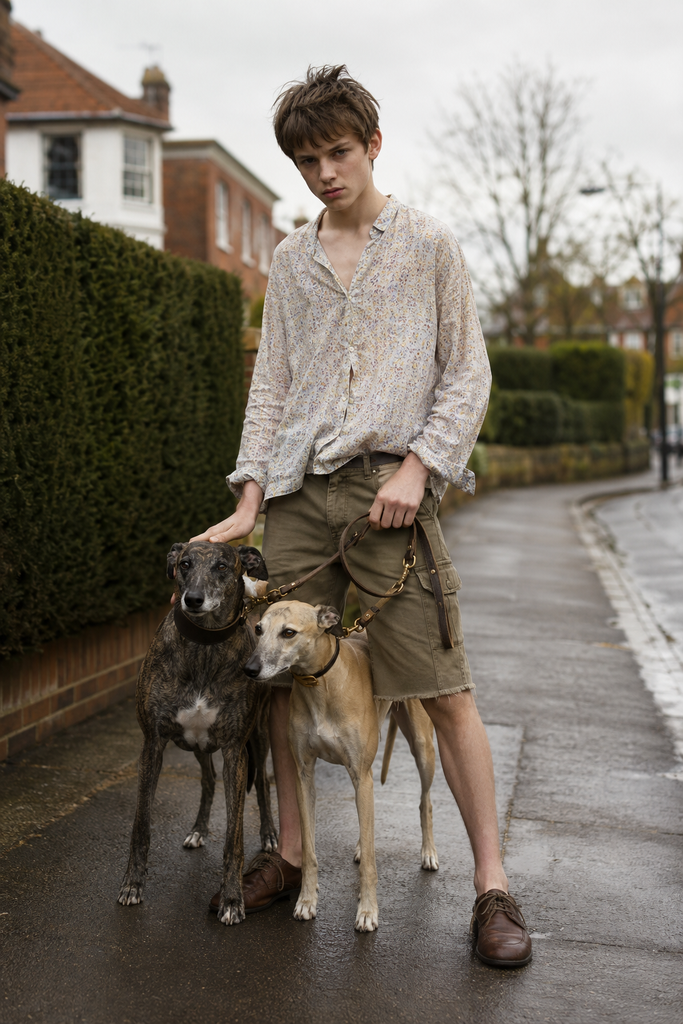
There are two whippets in the room when Crispin Alabaster Vale tells me that contemporary poetry has “failed the penis”.
The darker one is Scab.
The pale one is Antigone.
I know this because I have done my research.
I have done perhaps too much research.
For the past week I have read Vale’s poems, his interviews, the growing academic literature around his work, several thousand hostile comments beneath videos of his readings, and an eighty-seven-page doctoral chapter arguing that his recurring use of curtains represents “the semi-permeable membrane of bourgeois heterodomestic concealment”.
I mention this last article to him.
Crispin looks at me.
Scab looks at me.
Antigone puts her head beneath one paw.
“The curtains are curtains,” Crispin says.
I laugh.
Crispin does not.
We are sitting in the converted Methodist chapel in Suffolk where Vale now lives. The room is large and cool, with high windows, old wooden beams and very little that could reasonably be described as beige. There are books everywhere. Blake. Larkin. Keats. Plath. Baldwin. Wilde. Rimbaud. Anne Carson. Three different editions of Shakespeare. Something by A. C. Grayling with several furious Post-it notes protruding from the side.
A mug on the table says RAGE IS A LINE BREAK.
I ask Crispin whether the mug is ironic.
“No.”
This answer will become important.
Vale is fourteen, thin, pale and sharply handsome in the slightly unfinished way of adolescent boys. Today he is wearing a loose floral shirt, battered cargo shorts and brown shoes that look as though they belong to somebody’s classics tutor.
He sits sideways in an armchair with Antigone folded against one leg.
Scab refuses furniture on ideological grounds and remains on the rug.
At least, this is how Crispin explains it.
BENTAMETER: You’ve become associated with a new kind of outsider queer lyricism. Do you see yourself as an outsider artist?
CRISPIN: No.
BENTAMETER: No?
CRISPIN: I have Wi-Fi.
BENTAMETER: Right.
CRISPIN: Outsider artists traditionally lived in sheds and received messages from angels. I live in Suffolk and receive messages from publicists.
BENTAMETER: But perhaps outsider in the institutional sense?
CRISPIN: Oh, yes. Institutions hate me.
BENTAMETER: Do they?
CRISPIN: Constantly.
BENTAMETER: You’ve been nominated for major prizes.
CRISPIN: Exactly.
BENTAMETER: I’m not sure I understand.
CRISPIN: They nominate me so they can reject me more formally.
I write this down.
Crispin watches me write it down.
“You know I’m taking the piss, don’t you?”
I tell him I think the ambiguity is productive.
He stares at me for several seconds.
“Belgium must be exhausting.”
BENTAMETER: Professor Álvarez recently described your poetry as “administrative lyricism”. What did you make of that?
CRISPIN: Mateo is a beautiful man.
BENTAMETER: You’ve met?
CRISPIN: No.
BENTAMETER: Ah.
CRISPIN: But anyone with a doctorate in the Solo-Sexual Sublime has clearly survived something.
BENTAMETER: Do you agree with his argument that you turn emotional life into systems of government?
CRISPIN: Obviously.
BENTAMETER: Obviously?
CRISPIN: My body has poor governance.
BENTAMETER: That’s something you return to repeatedly.
CRISPIN: Yes. I’m currently seeking devolution.
I wait.
He does not elaborate.
BENTAMETER: Let’s start with your father.
Crispin sighs.
Not unhappily.
It is the sigh of a performer whose favourite lighting cue has just arrived.
CRISPIN: Must we?
BENTAMETER: He appears throughout your work.
CRISPIN: That is not my fault.
BENTAMETER: No?
CRISPIN: He keeps existing.
BENTAMETER: Your most famous poem turns him into a car park.
CRISPIN: Correct.
BENTAMETER: Was that intended as an image of patriarchal vacancy?
CRISPIN: It was intended as an image of Dad.
BENTAMETER: But the concrete, barriers, ticket machine—
CRISPIN: Have you met fathers?
BENTAMETER: Mine is actually very affectionate.
Crispin looks genuinely sorry for me.
CRISPIN: Christ.
BENTAMETER: Why “a car park”?
CRISPIN: Because calling him an insurance manager would have been too cruel.
BENTAMETER: Does he read your poetry?
CRISPIN: He says he doesn’t.
BENTAMETER: You don’t believe him?
CRISPIN: Last Christmas he referred to himself as “apparently municipal”.
BENTAMETER: So he reads it.
CRISPIN: Or Mother briefs him.
BENTAMETER: How is your relationship now?
CRISPIN: Switzerland.
BENTAMETER: Neutral?
CRISPIN: Expensive and full of tunnels.
I write this down.
Crispin watches me.
“You’re going to print that, aren’t you?”
I admit that I probably am.
He smiles for the first time.
“Good.”
Antigone gets up, walks across the room, turns around three times and lies down again.
Crispin watches her carefully.
“She’s revising her position.”
“On what?”
“The interview.”
I laugh.
Again, Crispin does not.
BENTAMETER: Your mother is represented very differently.
CRISPIN: Mother represents soft power.
BENTAMETER: That’s interesting.
CRISPIN: Is it?
BENTAMETER: I think so.
CRISPIN: Then write it down.
I do.
BENTAMETER: Her world in the poems is domestic. Wallpaper. Curtains. Cushions. Food.
CRISPIN: She believes civilisation is maintained through napkin rings.
BENTAMETER: And you don’t?
CRISPIN: I’ve seen no evidence.
BENTAMETER: Do you think readers sometimes misunderstand the cruelty in those poems? Your parents are often rendered almost grotesquely.
CRISPIN: Yes.
BENTAMETER: How?
CRISPIN: They think I’m exaggerating.
BENTAMETER: Aren’t you?
CRISPIN: Obviously.
There is a silence.
I realise I have walked into something.
Crispin scratches Antigone behind one ear.
“People are strange about poetry,” he says. “If you say your mother wrote her initials on a yoghurt, everyone understands. If you say she established a dairy-based apartheid state in the refrigerator, suddenly people want to know whether you’re being fair.”
BENTAMETER: Were you being fair?
CRISPIN: No.
BENTAMETER: Does that bother you?
CRISPIN: It was yoghurt, Amélie. We did not appear before the International Criminal Court.
BENTAMETER: I have to ask about the curtains.
Crispin closes his eyes.
Scab lifts his head.
CRISPIN: Why?
BENTAMETER: They’ve become perhaps your most discussed recurring image.
CRISPIN: This has been very difficult for the curtains.
BENTAMETER: Professor Pendergast-Smythe calls them—
CRISPIN: Textile border police.
BENTAMETER: Yes!
CRISPIN: She sent me the paper.
BENTAMETER: What did you think?
CRISPIN: I think Drusilla should have more sex.
I cough.
Crispin continues serenely.
CRISPIN: Not because the paper is wrong. Just generally.
BENTAMETER: So you do think there’s something in her reading?
CRISPIN: The curtains separate inside from outside.
BENTAMETER: Exactly.
CRISPIN: That is also what curtains do.
BENTAMETER: But in your poetry—
CRISPIN: Yes.
BENTAMETER: —that function becomes—
CRISPIN: Curtain-like.
I stop.
Crispin waits.
Eventually I say, “You enjoy this.”
“Immensely.”
BENTAMETER: What about Saskia van der Mirth’s theory that the objects themselves are morally implicated?
For the first time, Crispin sits forward.
CRISPIN: Saskia understands.
BENTAMETER: Really?
CRISPIN: Finally.
BENTAMETER: So the curtains are guilty?
CRISPIN: Completely.
BENTAMETER: Of what?
Crispin looks offended.
“If I knew that, they’d already be in prison.”
I nod before realising I have nodded.
He notices.
“Oh my God,” he says softly. “You people will accept anything.”
BENTAMETER: Marcus Bellamy.
CRISPIN: Allegedly.
BENTAMETER: He appears across the early work.
CRISPIN: Through no effort of his own.
BENTAMETER: Was he your first love?
Crispin considers this.
“No. He was my first administrative catastrophe.”
BENTAMETER: What’s the distinction?
CRISPIN: Love requires information.
BENTAMETER: And you didn’t know him?
CRISPIN: I knew plenty.
BENTAMETER: Such as?
CRISPIN: Geography set two. Oasis. Blue-and-white trainers. Bites pencils. Sleeves often rolled. Poor political instincts.
BENTAMETER: What were his politics?
CRISPIN: He said Jeremy Clarkson was funny.
BENTAMETER: Ah.
CRISPIN: Exactly.
BENTAMETER: And yet you remained obsessed with him.
CRISPIN: Have you seen shoulders?
BENTAMETER: In general?
CRISPIN: They are devastating.
BENTAMETER: Did Marcus know how you felt?
CRISPIN: Absolutely not.
BENTAMETER: Never?
CRISPIN: I wrote approximately nine thousand lines of poetry about him and avoided eye contact for eighteen months.
BENTAMETER: Very English.
CRISPIN: Thank you.
BENTAMETER: That wasn’t entirely a compliment.
CRISPIN: Then I withdraw my gratitude.
BENTAMETER: “The Boy I Wanted Had Terrible Shoes” is much quieter than most of your poems.
Crispin’s expression changes slightly.
The performance does not disappear, but something behind it becomes still.
CRISPIN: Yes.
BENTAMETER: Do you find it difficult to read?
CRISPIN: No.
A pause.
“Yes.”
BENTAMETER: Why?
He scratches Scab’s neck.
“Because nothing happens.”
BENTAMETER: That’s why it hurts?
CRISPIN: Probably.
BENTAMETER: He borrows a pencil.
CRISPIN: Yes.
BENTAMETER: He gives it back.
CRISPIN: Selfish bastard.
BENTAMETER: You wanted him to keep it?
CRISPIN: I wanted him to understand that borrowing HB stationery had entered the realm of sacred exchange.
BENTAMETER: Which he didn’t.
CRISPIN: Marcus was not a natural semiotician.
BENTAMETER: Do you still have the pencil?
Crispin looks at me.
Then towards a small wooden box on a shelf.
Then back at me.
“No.”
I look at the box.
He says, “You have extremely colonial eyes.”
I stop looking at the box.
BENTAMETER: School is another major institution in your work.
CRISPIN: Unfortunately.
BENTAMETER: You once wrote, “Mud is fascist.”
CRISPIN: Correct.
BENTAMETER: What does that mean?
CRISPIN: Mud operates through compulsory adhesion.
BENTAMETER: You’re joking.
CRISPIN: Finally.
BENTAMETER: So it doesn’t mean anything?
CRISPIN: Of course it means something.
BENTAMETER: What?
CRISPIN: I don’t like mud.
BENTAMETER: That’s it?
CRISPIN: Why must everything be a doctoral emergency?
BENTAMETER: Because you describe rugby as part of a system manufacturing masculinity.
CRISPIN: Yes, but also it’s shit.
BENTAMETER: Those aren’t mutually exclusive.
Crispin studies me.
“That was almost good.”
I feel absurdly pleased.
This is the moment I realise he has trained me.
BENTAMETER: Your changing-room poems have attracted particularly intense queer readings.
CRISPIN: Queer academics love a changing room because they survived one.
BENTAMETER: “Lynx Africa” is often considered one of your strongest pieces.
CRISPIN: It’s deodorant.
BENTAMETER: The poem, Crispin.
CRISPIN: I know.
BENTAMETER: It’s about wanting to belong to the same group you fear will reject you.
He looks down at Scab.
“Yes.”
This answer is different.
I wait.
Crispin eventually continues.
“There’s a thing boys do where everyone is pretending they aren’t watching everyone else become a body.”
BENTAMETER: That’s beautiful.
CRISPIN: It’s disgusting.
BENTAMETER: Both, perhaps?
CRISPIN: Yes.
He pauses.
“And Lynx Africa smells like masculinity being covered up at a crime scene.”
I tell him that’s an extraordinary line.
He brightens.
“I know.”
BENTAMETER: You write about God almost as frequently as you write about your parents.
CRISPIN: God is essentially Dad with meteorological capacity.
BENTAMETER: Are you an atheist?
CRISPIN: On weekdays.
BENTAMETER: What happens at weekends?
CRISPIN: I become too angry at Him not to believe temporarily.
BENTAMETER: That sounds almost theological.
CRISPIN: Don’t start.
BENTAMETER: Your religious poems often treat shame as administration.
CRISPIN: Religion takes ordinary embarrassment and gives it filing cabinets.
BENTAMETER: You resent the idea of being watched.
CRISPIN: Obviously.
BENTAMETER: Yet your poetry makes private feelings extraordinarily public.
CRISPIN: Yes.
BENTAMETER: Isn’t that contradictory?
CRISPIN: No. Surveillance is when you look at me. Poetry is when I force you to.
I stop writing.
That one, I tell him, is actually excellent.
Crispin rolls his eyes.
“Please don’t tell Professor Álvarez. He’ll invent a noun.”
BENTAMETER: You parody canonical poets constantly. Blake, Shelley, Shakespeare, Larkin—
CRISPIN: They started it.
BENTAMETER: Started what?
CRISPIN: Poetry.
BENTAMETER: Fair.
CRISPIN: Somebody had to stop them.
BENTAMETER: Do you love these poets?
CRISPIN: Obviously.
BENTAMETER: Even when you mutilate them?
CRISPIN: Especially then.
BENTAMETER: Belladonna Chukwu-Finch calls your approach “canonical squatting”.
CRISPIN: Belladonna sounds like somebody who should own a falcon.
BENTAMETER: Do you know her?
CRISPIN: No.
BENTAMETER: Her argument is that you enter canonical poems and refuse their terms of tenancy.
CRISPIN: That’s ridiculous.
BENTAMETER: I thought you might like it.
CRISPIN: I love it.
BENTAMETER: Why parody? Why not simply write your own forms?
Crispin looks genuinely puzzled.
“I do.”
BENTAMETER: But when you use Blake—
CRISPIN: Blake is dead.
BENTAMETER: Yes.
CRISPIN: He isn’t using it.
BENTAMETER: Using what?
CRISPIN: Blake.
I begin to ask another question.
Crispin interrupts.
“Also, English literature spent several centuries telling boys like me that these poems belonged to everybody.”
BENTAMETER: And?
CRISPIN: Surprise.
That is all he says.
BENTAMETER: Your poetry is often technically imperfect.
CRISPIN: Thank you.
BENTAMETER: That was not necessarily—
CRISPIN: I accept.
BENTAMETER: Some critics think your mistakes are part of the work.
CRISPIN: Some critics need hobbies.
BENTAMETER: Do you revise?
CRISPIN: Constantly.
BENTAMETER: So you care about craft.
CRISPIN: Don’t print that.
BENTAMETER: Why?
CRISPIN: Reputation.
BENTAMETER: You’ve attacked “craft” publicly.
CRISPIN: I attack salad publicly. I still eat cucumber.
BENTAMETER: So when you say craft is bourgeois—
CRISPIN: Sometimes I’m fourteen.
BENTAMETER: That may be the most self-aware thing you’ve said today.
CRISPIN: Fuck.
BENTAMETER: We have to discuss the T. S. Eliot Prize.
Crispin immediately removes Antigone from his lap, places her carefully on the chair beside him and sits upright.
“Very well.”
It is unmistakably theatrical.
I allow it.
BENTAMETER: You’ve had a difficult relationship with the committee.
CRISPIN: They began it.
BENTAMETER: By nominating you?
CRISPIN: Aggressively.
BENTAMETER: Most poets regard nomination as an honour.
CRISPIN: Most poets wear scarves indoors and describe sandwiches as lunch meetings.
BENTAMETER: You wear scarves indoors.
CRISPIN: Mine are oppositional.
BENTAMETER: You famously attacked the committee.
CRISPIN: Allegedly.
BENTAMETER: There is video.
CRISPIN: Deepfake.
BENTAMETER: You subsequently wrote a poem about their response.
CRISPIN: Further deepfake.
BENTAMETER: In your handwriting.
CRISPIN: AI has become extraordinary.
BENTAMETER: Crispin.
He smiles.
CRISPIN: Fine.
BENTAMETER: Do you actually want the prize?
There is a beat.
“Yes.”
BENTAMETER: Really?
CRISPIN: Of course.
BENTAMETER: Then why insult them?
CRISPIN: Because they didn’t give it to me.
BENTAMETER: That’s incredibly childish.
CRISPIN: Amélie.
BENTAMETER: Yes?
CRISPIN: Look at me.
I do.
He spreads his hands.
Fourteen.
Point taken.
BENTAMETER: What would you do if you eventually won?
CRISPIN: Decline it.
BENTAMETER: Seriously?
CRISPIN: Absolutely.
BENTAMETER: Why?
CRISPIN: Integrity.
BENTAMETER: You just said you want it.
CRISPIN: I want to win it.
BENTAMETER: Not receive it.
CRISPIN: Precisely.
BENTAMETER: That distinction seems—
CRISPIN: Vital.
BENTAMETER: —insane.
Crispin looks pleased.
“Now you understand poetry.”
BENTAMETER: How much of “Crispin Vale” is a persona?
He is quiet for longer than I expect.
Scab gets up and places his long head on Crispin’s knee.
Vale runs his fingers along the dog’s forehead.
“I don’t know.”
BENTAMETER: Does that worry you?
CRISPIN: Sometimes.
BENTAMETER: Because people expect you to be angry?
CRISPIN: People expect me to be Crispin.
BENTAMETER: And you are Crispin.
CRISPIN: Exactly. Fucking nightmare.
BENTAMETER: Do you ever feel trapped by the recurring imagery? Your father, the Volvo, curtains, Marcus—
CRISPIN: Yes.
BENTAMETER: Then why keep returning to it?
CRISPIN: Because they keep being true.
He thinks.
“Also people like the curtains.”
BENTAMETER: So you do sometimes write for the audience.
CRISPIN: No.
BENTAMETER: You literally just—
CRISPIN: Next question.
BENTAMETER: What do Scab and Antigone represent?
Crispin looks horrified.
“They’re dogs.”
BENTAMETER: I meant in your life.
CRISPIN: Also dogs.
BENTAMETER: They appear in later work as a kind of domestic alternative—
CRISPIN: Stop.
BENTAMETER: —to the family—
CRISPIN: Amélie.
BENTAMETER: Yes?
CRISPIN: Sometimes a whippet is just a whippet.
Scab sneezes.
Crispin points at him.
“Freud.”
BENTAMETER: Which is Scab again?
“The dark one.”
BENTAMETER: Why Scab?
CRISPIN: I liked the word.
BENTAMETER: And Antigone?
CRISPIN: She objected to unjust authority.
BENTAMETER: The dog?
CRISPIN: She wouldn’t come downstairs.
BENTAMETER: Ah.
CRISPIN: For forty minutes.
BENTAMETER: So you named her after Sophocles’ heroine?
CRISPIN: Obviously.
BENTAMETER: Because she wouldn’t come downstairs.
CRISPIN: Resistance begins locally.
I write this down.
He watches me.
I put my pen down.
Crispin laughs so hard he has to lean against Scab.
It is the first time all afternoon I have heard him laugh without armour.
BENTAMETER: What do you think people get most wrong about you?
CRISPIN: That I hate everything.
BENTAMETER: You do cultivate that impression.
CRISPIN: Yes.
BENTAMETER: So what do you love?
He thinks.
“The dogs.”
Scab’s tail moves once.
“Poetry.”
A pause.
“Mother sometimes.”
Another pause.
“Boys, disastrously.”
BENTAMETER: Your father?
Longer pause.
Crispin looks towards the window.
“Don’t be vulgar.”
I leave it there.
BENTAMETER: Do you miss Marcus?
CRISPIN: No.
Too quickly.
BENTAMETER: Do you ever speak?
CRISPIN: Occasionally.
BENTAMETER: Does he read the poems?
CRISPIN: He says some are funny.
BENTAMETER: That must be difficult.
CRISPIN: It is an act of psychological warfare.
BENTAMETER: Why?
CRISPIN: Imagine turning somebody into a metaphysical catastrophe and they say, “lol, good one”.
BENTAMETER: What would you prefer?
CRISPIN: Death.
I look up.
“His or yours?”
Crispin considers.
“Poetry’s.”
BENTAMETER: Are the three Theos real?
He stares at me.
“That question has been embargoed by Brussels.”
BENTAMETER: Brussels?
CRISPIN: Yes.
BENTAMETER: Why would—
Then I stop.
Crispin smiles.
“Good.”
BENTAMETER: You seem suspicious of academics, but academics have taken your work very seriously.
CRISPIN: I adore academics.
BENTAMETER: You’ve spent most of this interview mocking them.
CRISPIN: That is how I adore people.
BENTAMETER: What do you think of the growing field of Vale studies?
CRISPIN: We must stop it before somebody gets tenure.
BENTAMETER: Too late.
CRISPIN: Then evacuate.
BENTAMETER: Do any of the theories genuinely interest you?
He thinks.
“The municipal libido is quite good.”
BENTAMETER: Really?
CRISPIN: No.
I sigh.
“See?” Crispin says. “Now you’re doing it.”
BENTAMETER: Doing what?
CRISPIN: Sighing.
BENTAMETER: And?
CRISPIN: Passive aggression.
BENTAMETER: I’m Belgian.
CRISPIN: Continental Dad.
BENTAMETER: I am a lesbian woman in my twenties.
CRISPIN: Emotionally, anything is possible.
Towards the end of our conversation, I ask Vale what he wants.
It is the kind of question interviewers ask when they hope the conversation will suddenly reveal its hidden architecture.
Crispin immediately recognises this.
“What do you mean?”
“From poetry. From all of this.”
He looks around the room.
At the books.
At the dogs.
At the high former-chapel windows.
At the recorder between us.
“I want people to stop telling children that something isn’t important because it won’t matter when they’re thirty.”
I wait.
This time there is no joke.
“They might be right,” he says. “That’s not the point.”
“What is?”
“It matters now.”
Scab has fallen asleep against his ankle.
Antigone is upside down on the chair.
Vale scratches at a loose thread on his shorts.
“When Marcus borrowed that pencil, I thought about it for weeks. Adults hear that and think the funny part is that it was only a pencil.”
“And you don’t?”
“No.”
“What’s the funny part?”
“That I thought about it for weeks.”
He smiles.
“That’s different.”
It is perhaps the clearest thing Crispin Vale says all afternoon.
Then he ruins it.
“Also the pencil had tremendous queer agency.”
I look at him.
He keeps his face perfectly still.
I refuse to write it down.
“Growth,” he says.
At the door, I ask him one final question.
BENTAMETER: If you could say one thing directly to your critics, what would it be?
Crispin considers this gravely.
Scab and Antigone stand behind him in the hallway.
“Which critics?”
“All of them.”
“Academics?”
“Yes.”
“Prize committees?”
“Yes.”
“People who think the poems are terrible?”
“Yes.”
“People who think they’re brilliant?”
“Yes.”
“Dad?”
“If you like.”
He folds his arms.
For a moment, standing beneath the old Methodist arch with two whippets at his legs, he looks almost impossibly young.
Then Crispin Alabaster Vale says:
“Please stop looking for the real me beneath the poems.”
I ask why.
He looks genuinely astonished.
“Because this is him.”
Then he closes the door.
A second later it opens again.
Crispin sticks his head out.
“And tell Pendergast-Smythe the curtains have retained counsel.”
The door shuts.
Through it, very faintly, I hear him say:
“Scab, don’t lick that.”