Dr Helena Krupp, Institute for Outsider Textual Forms, Vienna
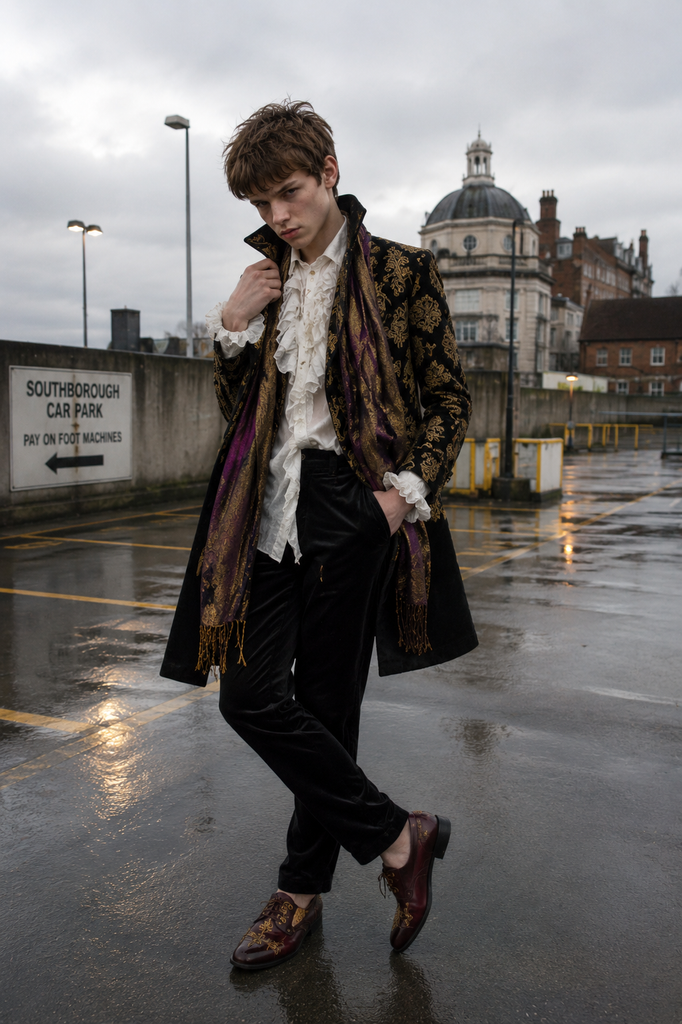
There is a temptation, when discussing the recent work of Crispin Alabaster Vale, to describe it as a maturation.
This would be a mistake.
Vale has not matured.
He has expanded his target radius.
The poems collected in The Genocide Codex belong largely to what we might call Vale’s domestic-abjection period: the father as failed architecture, the mother as soft furnishing with coercive properties, the body as an inefficient local authority, school as a machine for manufacturing shame, and heterosexual suburban England as a vast system of beige emotional rationing.
These poems are private in origin even when their metaphors become absurdly large. Nuclear war, theology, masculinity, empire, the state: all are ultimately dragged back into the Vale household.
The apocalypse ends in Tunbridge Wells.
God becomes a headmaster.
The British Empire becomes a filing system for preventing Crispin from kissing Marcus Bellamy.
History itself is repeatedly reduced to Julian Vale standing in a hallway holding a mug.
This was both the limitation and the extraordinary comic force of the early Vale.
He was incapable of perceiving any event except as evidence in the prosecution of his own childhood.
The world existed chiefly as an extended metaphor for Dad.
What has changed in Vale’s newest work is not this narcissism.
It is its jurisdiction.
With his recent self-appointment as Gay Teenage Poet Laureate of the Known Universe, Vale has moved decisively from the confessional lyric into something much stranger: a form of instantaneous public outsider poetry in which contemporary events are absorbed into an already established private mythology.
He no longer waits for the world to resemble his emotional life.
He simply declares that it does.
The title itself deserves attention.
“Gay Teenage Poet Laureate of the Known Universe” is, on one level, exactly the sort of ludicrous self-coronation we should expect from a fourteen-year-old who has previously treated literary criticism as an act of personal trespass.
But it is also a surprisingly accurate statement of Vale’s emerging poetics.
Each word performs work.
Gay identifies not merely sexuality but interpretive position. Vale approaches public life through the experience of queer adolescence: surveillance, shame, masculinity, forbidden desire, institutional authority, hostile classification.
Teenage is equally important. Vale does not seek to transcend adolescent disproportion. He weaponises it. In his work, everything is either intolerable, historic, erotic, fascist, humiliating, or happening specifically to him.
Frequently it is all five.
Poet Laureate is an act of institutional theft.
The laureate is traditionally appointed by authority.
Vale appoints himself.
This is characteristic.
Much of his career consists of attempting to solve exclusion from institutions by declaring himself superior to them.
Prize committees reject him; he establishes a higher court.
Critics dispute his craft; he declares craft politically compromised.
Adults possess cultural authority; he expands his constituency to the universe.
And then there is the Known Universe.
The phrase is funny because of its scale.
It is also revealing.
Britain is too small for Vale’s grievance.
So is Earth.
His imagined office must exceed every institution capable of refusing him.
The laureateship therefore operates simultaneously as adolescent fantasy, satirical device, outsider-art strategy and defensive architecture.
Nobody can sack the Poet Laureate of the Known Universe because nobody appointed him.
This is pure Vale.
The recent topical poems demonstrate the consequences of this transformation.
In the earlier work, news and politics tended to appear as secondary material, appropriated into the symbolic world of the adolescent bedroom. In the culturally reactive poems, public events become the originating stimulus.
The direction of travel has reversed.
The bedroom now invades the news.
A wildfire becomes a sonnet whose ethical centre is briefly humane before its speaker suggests that any remaining combustion might usefully proceed to Tunbridge Wells, where his father’s Volvo is parked.
A by-election becomes a mock-heroic account of a politician defeating himself, only for the entire constitutional spectacle to collapse in the final couplet into Julian Vale leaving a family argument and later claiming victory.
An anti-homosexuality bill in Ghana becomes an occasion for one of Vale’s oldest obsessions: authority presenting inherited repression as indigenous virtue.
Yet even here, once colonial law, religion, nationalism and state surveillance have been invoked, the poem cannot resist returning to the domestic Vale lexicon: fear becomes “administrative”; repression resembles fatherhood; state power behaves like a parent entering the bedroom without knocking.
Vale remains incapable of leaving home.
He has simply discovered that the world contains many homes.
This is a significant artistic development.
Not necessarily an improvement.
Vale’s earliest poems possessed the peculiar integrity of someone who did not yet understand that he had an audience. Their worst metaphors appeared without quotation marks around them. Their bathos was involuntary. Their melodrama had not yet learned that melodrama could be a brand.
The culturally reactive Vale is more dangerous because he has begun to understand Crispin Vale.
One senses, increasingly, that he knows what happens when he mentions curtains.
He knows that readers are waiting for the father.
He knows that a sudden reference to Marcus Bellamy’s terrible shoes will function as a refrain.
He knows, disastrously, that “the body as bureaucracy” has become recognisable Valean property.
Outsider artists who acquire an audience always face this problem.
Once the outsider becomes conscious of the aesthetic categories through which the outside world receives him, can the work remain genuinely outsider?
Vale’s answer appears to be characteristically aggressive: he converts self-consciousness into further material.
If the audience expects Crispin Vale, then Crispin Vale will give them more Crispin Vale than they can medically tolerate.
This produces a fascinating oscillation between authenticity and performance.
At his best, Vale’s new topical poems contain the same sudden emotional accuracy found in his earlier work.
At his worst, they resemble a gifted child performing an imitation of himself while standing on a chair.
Fortunately, Vale is unusually good at standing on chairs.
The rapid-response form may actually suit his weaknesses better than traditional poetry does.
Vale has always suffered from excessive metaphorical acceleration. Given too much room, he will move from loneliness to municipal government to genital shame to nuclear deterrence to yoghurt lids in fewer than twenty lines.
In conventional lyric poetry this can feel uncontrolled.
In topical satire it becomes velocity.
His lack of proportion becomes a method.
His inability to leave anything at the appropriate emotional scale becomes the joke.
A normal satirist observes that a public figure has behaved absurdly.
Vale behaves as though the absurdity has personally violated his curtains.
This is not merely comic exaggeration.
It is the organising principle of the work.
The new poems also complicate Vale’s relationship with outsider art itself.
Historically, the outsider artist is imagined as producing beyond, beneath, or in ignorance of established cultural institutions.
Vale knows perfectly well that the institutions exist.
He hates them.
He reads them.
He insults them.
He wants their prizes.
He then claims their prizes are meaningless when he loses them.
This does not disqualify him from the outsider tradition.
It modernises it.
Vale is not outside the institution because he cannot see the door.
He is outside because he has been ejected from the foyer and has responded by declaring the pavement a sovereign republic.
The self-selected laureateship should therefore be understood as more than a joke.
It is Vale’s most complete institutional artwork to date.
He has created an office with no appointing body, no geographic boundary, no constitutional basis, no salary, no term limit and no mechanism of removal.
The office exists because Vale says it does.
Its authority derives from repetition.
Each new poem becomes both cultural response and ceremonial act.
The laureate speaks; therefore the laureateship exists.
This resembles the logic of childhood monarchy, avant-garde manifesto, internet persona and outsider practice simultaneously.
It may also be the first literary office in Britain whose constitutional basis is approximately:
fuck you, I said I am.
There is, however, a moral danger in the new form.
Topical satire does not grant the poet the protective distance of private misery.
Vale is now writing about real disasters, real victims, real political persecution and real public violence.
His instinct is always to turn suffering into language immediately.
This can produce extraordinary compression.
It can also produce grotesque trivialisation.
Vale’s emerging success will depend upon whether he can retain the distinction already visible in his best recent work: victims are not the target; power, hypocrisy and Crispin himself are.
The Midlands fire sonnet succeeds because it begins by insisting upon the safety of children, residents and firefighters before allowing Vale’s private pathology to hijack the final sestet.
The joke is not that people’s homes burned.
The joke is that Crispin cannot encounter even catastrophe without eventually remembering his father’s Volvo.
Likewise, his Ghana poem is strongest when its obscenity is directed upward: legislators, clergy, the state, inherited colonial criminal law, public moral cowardice.
If Vale loses that distinction, he will become merely cruel.
If he preserves it, cruelty becomes one of the instruments by which hypocrisy is stripped of its ceremonial clothing.
This brings us to the central question raised by the new work.
Has Crispin Vale become a satirist?
I do not think so.
Satire implies a certain distance between observer and object.
Vale has none.
He does not stand outside the burning building describing its architecture.
He runs inside, discovers his father’s curtains, accuses God of procurement irregularities, calls a cabinet minister a wardrobe, masturbates metaphorically in the stairwell and emerges carrying a sonnet.
This is something else.
Vale is developing a form we might provisionally call reactive confessional public lyric: the conversion of current events into private symbolic crisis at sufficient speed that the distinction between news commentary and adolescent breakdown becomes impossible to maintain.
The result is frequently stupid.
It is frequently tasteless.
It is occasionally dishonest.
It is sometimes technically dreadful.
And then, as has always been the problem with Crispin Vale, he writes one line which reveals that beneath the performance, the obscenity and the swan-like litigation, he has seen something clearly.
That is the development worth watching.
The boy who once believed his father was a car park now believes the entire world is badly zoned.
The change is not that Crispin Vale has stopped writing about himself.
The change is that he has appointed himself to write about everything.
God help the known universe.