Analysing the Errata to Find the Hidden Vale
Nathaniel Pembroke-Hughes Third-Year Undergraduate, BA English Literature University of Warwick
Submitted to the Warwick Undergraduate Review of English Studies, October 2026
With thanks to Antonia Vale for access to the early notebooks, Professor Mateo Luis Álvarez for his generous correspondence, and Crispin Alabaster Vale for permitting me to exist briefly in his literary vicinity.
Abstract
The poetry of Crispin Alabaster Vale (2012–) has traditionally been approached through the critical frameworks of administrative lyricism (Álvarez), domestic object complicity (van der Mirth), and reactive confessional public lyric (Krupp). Yet surprisingly little scholarly attention has been paid to the surviving manuscript evidence of Vale’s compositional process.
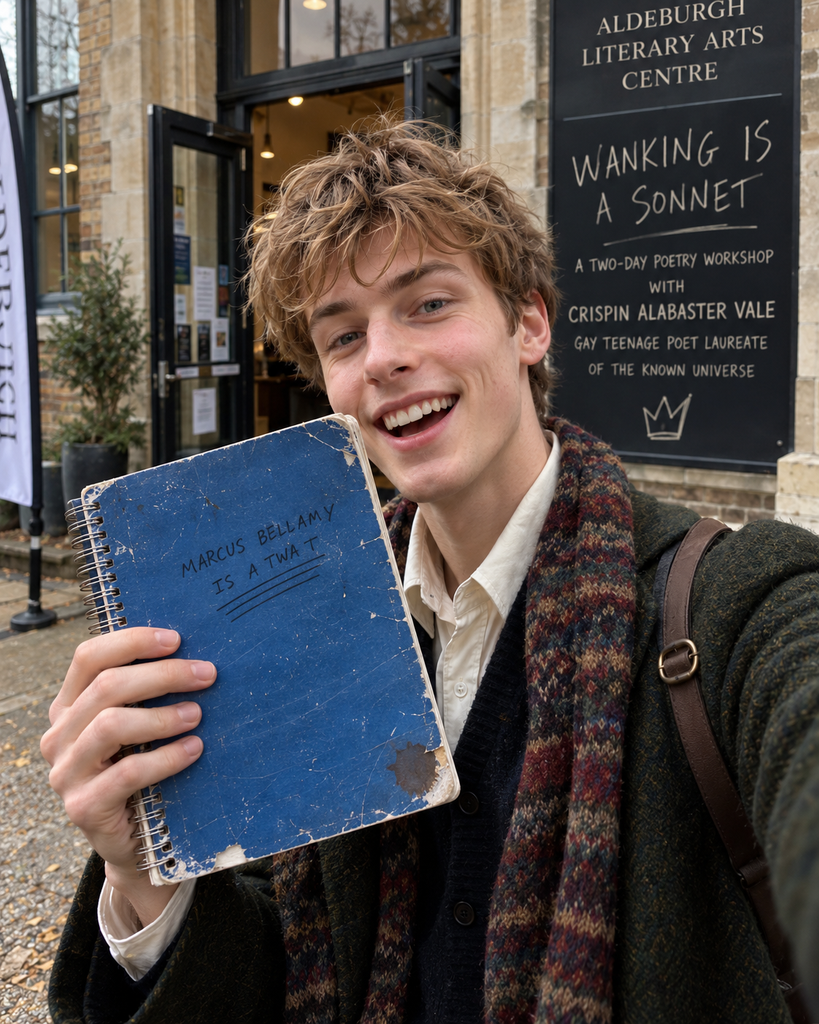
This paper presents the first systematic examination of eleven early notebooks, three school exercise books, a damaged WHSmith receipt and a loose sheet of paper bearing the words MARCUS BELLAMY IS A TWAT written seventeen times.
The materials were examined during two supervised visits to the Vale family residence in Tunbridge Wells, with subsequent access to selected digitised manuscripts.
My central argument is that Vale’s apparent spontaneity conceals a highly sophisticated process of revision, deletion, substitution and what I shall term pre-emptive counter-canonical self-interruption.
The most important evidence occurs in an early draft of This Be the Worst, in which the poet initially wrote:
But they were cunted in their turn
before deleting the line.
I propose that this apparently minor intervention constitutes one of the most significant moments of self-definition in contemporary British queer poetry.
I am aware that this is a substantial claim.
I intend to defend it.
Keywords: Crispin Vale; genetic criticism; queer poetics; textual revision; Philip Larkin; administrative lyricism; curtains; cunted.
I. Introduction: The Privilege of the Archive
On 3 September 2026, at approximately 11:42 a.m., I held in my hands a notebook belonging to Crispin Alabaster Vale.
It was blue.
The spiral binding was damaged.
A small brown stain appeared on the lower-right corner of the cover.
Mrs Antonia Vale suggested that this was probably tea.
I have found no conclusive evidence supporting this identification.
The experience was, nevertheless, extraordinary.
Few undergraduate researchers are afforded direct access to the compositional materials of a living poet, fewer still to those of a writer whose work is already transforming the landscape of contemporary queer lyricism.
And fewer, I suspect, have experienced this privilege while the poet’s mother asks whether they would like a ham sandwich.
I accepted.
The sandwich was excellent.
It would be inappropriate to suggest that this ordinary domestic hospitality carried any particular symbolic significance. Nevertheless, the reader familiar with Vale’s repeated treatment of kitchens, maternal authority and food-based territoriality will appreciate the complex position in which I found myself.
I was eating a sandwich prepared by the woman who had inspired Mum Is a Wallpaper Lie.
The mayonnaise was very good.
I have attempted to maintain critical objectivity throughout the present study.
My dissertation supervisor, Dr Eleanor Whitcombe, has suggested that I should state this intention explicitly, particularly after reading an earlier version of this introduction in which I described holding the notebook as “the moment literary history opened its legs”.
I accept that this was inappropriate.
I meant pages.
During the research visit, I discovered something remarkable.
Vale revises.
This observation may appear obvious. All poets revise, although certain contemporary practitioners have occasionally attempted to persuade the public otherwise.
Yet Vale’s established critical persona depends upon a particular mythology of adolescent spontaneity: the furious child, isolated in his bedroom, producing verses of disproportionate rage and extraordinary metaphorical instability.
The prevailing assumption has been that Vale writes first and thinks afterwards.
The manuscripts demonstrate something considerably more interesting.
He thinks while writing.
Sometimes he thinks quite hard.
And sometimes, faced with a line that any responsible editor would have removed immediately, he removes it himself.
This is the Hidden Vale.
Not a second personality, nor a secret poetic identity, but the evidence of an artist whose apparent indiscipline may itself be the product of significant compositional discipline.
The question is no longer simply whether Vale is good.
It is whether Vale knows precisely how good he is.
I believe he does.
He has told me so.
II. The Larkin Palimpsest: A Cunt Too Far
The most consequential discovery in the Vale notebooks concerns the manuscript evolution of This Be the Worst, his notorious revision of Philip Larkin’s This Be the Verse.
The published poem begins:
they cunt you up, your mum and dad, then ask if you’ve tried getting fitter;
This opening establishes both an immediate intertextual relationship with Larkin and a distinctively Valean escalation of vulgarity.
Larkin’s original verb is transformed from an ordinary expletive into a more aggressively embodied linguistic intervention.
One might argue that the substitution is merely adolescent provocation.
One would be wrong.
Or, at least, insufficiently attentive.
The crucial evidence lies in the second stanza.
In Notebook V3, folio 17r, Vale originally wrote:
But they were cunted in their turn
He then crossed out the entire line.
Not once.
Twice.
The second cancellation is particularly vigorous, penetrating the paper and leaving a faint impression on the following page.
I examined this impression under angled light.
It was unmistakably cunted.
I have included a diagram in Appendix B.
Dr Whitcombe has questioned whether a diagram is necessary.
I believe it is.
2.1 The significance of the discarded line
At first glance, the deletion seems entirely explicable: Vale recognised that the line remained structurally too close to Larkin’s original.
Yet this explanation, although valid, overlooks its extraordinary implications.
Consider the movement:
Larkin: generational injury transmitted through inherited psychological damage.
Early Vale: generational injury transmitted through the more aggressive vocabulary of genitalised familial catastrophe.
Published Vale: a shift away from explanatory genealogy towards immediate parental obscenity.
By abandoning the second-stanza echo, Vale refuses to permit Larkin’s framework to govern his own interpretation of familial misery.
He is no longer merely parodying Larkin.
He is escaping him.
The discarded word cunted therefore occupies a paradoxical position in the textual history.
It is at once the most Valean word in the draft and the word whose removal allows the poem to become more fully Valean.
This is what I mean by pre-emptive counter-canonical self-interruption.
Dr Whitcombe has written beside this phrase:
Editing, Nathaniel. It is called editing.
I respectfully disagree.
The deleted line reveals the moment at which the poet recognises that linguistic resemblance is not necessarily literary independence.
To put this more simply: Crispin Vale needed to stop being Larkin in order to become Crispin Vale.
It is difficult to overstate the importance of this discovery.
I have attempted to do so on three separate occasions.
2.2 Correspondence with the poet
On 8 September, I contacted Vale through his public correspondence address, asking whether he could clarify his reason for deleting the line.
His reply arrived at 14:06.
Because Larkin already wrote it, you tit.
This communication is of exceptional significance.
First, Vale explicitly confirms awareness of the intertextual proximity.
Second, he acknowledges authorial intention.
Third, and most importantly, his employment of the vocative you tit situates the researcher within the poet’s existing vocabulary of aggressive intimacy.
One cannot reasonably claim that this constitutes affection.
Nevertheless, it is difficult to interpret it as complete indifference.
I have preserved the email.
Dr Whitcombe has advised me not to frame it.
I have not framed it.
Yet.
III. The Architecture of Omission: Dad Is a Car Park
Perhaps the most startling revelation from the early notebooks concerns the opening of Dad Is a Car Park.
The published text begins:
My father is a car park.
In the earliest surviving version, however, the line reads:
My father is a multi-storey car park.
Vale subsequently removed multi-storey.
This apparently modest excision transforms the poem.
The original describes an identifiable type of structure. The revision makes a much more radical ontological claim.
Julian Vale is not merely a particular car park.
He is car parkness.
He becomes the entire category of municipal automotive containment.
This is a remarkable leap for a boy of twelve.
It is all the more remarkable because Vale’s father was, at the time, still alive and employed in insurance.
3.1 From structure to condition
The deletion of multi-storey eliminates descriptive limitation.
The father ceases to possess a fixed number of floors.
He becomes potentially infinite.
The published poem’s later movement towards barriers, ticket machines and reversing vehicles thus takes place within an architecture of deliberate unspecified scale.
I propose that this anticipates Vale’s eventual self-appointment as Gay Teenage Poet Laureate of the Known Universe.
In both instances, he rejects geographical restriction.
First, the father becomes all car parks.
Later, Crispin becomes all laureates.
The symmetry is striking.
Dr Whitcombe has described this argument as “a considerable stretch”.
I have removed the word undeniable from my original conclusion.
3.2 A second, previously unknown variant
A still earlier pencil draft contains an alternative opening:
Dad is a fucking multi-storey car park.
This is followed by the marginal annotation:
too obvious.
Here, for the first time, we encounter the possibility that Vale’s celebrated obscenity may represent not a failure of restraint but a selective rhetorical instrument.
He does not always choose the most offensive available word.
Sometimes he chooses the better line.
I admit that when I discovered this, I became quite excited.
Mrs Vale asked whether I needed water.
I said no.
She brought some anyway.
IV. Curtains, Criminality and the Ethics of Deletion
The notebooks also offer substantial new evidence concerning Vale’s most disputed recurring image.
The published Mum Is a Wallpaper Lie contains the famous accusation:
The curtains know what they did.
This line has generated an extraordinary body of scholarship.
Pendergast-Smythe interprets the curtains as textile border police. Watanabe-Lopez reads them as temporal mechanisms of disclosure. Van der Mirth argues that they possess genuine moral agency within the Valean poetic universe.
My manuscript research reveals that the earliest surviving version was much less ambiguous.
It reads:
The curtains are fucking grasses.
This is remarkable.
In the original, Vale explicitly identifies the curtains as informants.
The revision converts direct accusation into an epistemological problem.
What do the curtains know?
What precisely did they do?
Why will they not speak?
The deletion, I would argue, creates the interpretive space in which the entirety of contemporary Curtain Studies subsequently develops.
Without it, Dr Pendergast-Smythe might never have written Pleats of Surveillance.
Dr van der Mirth might never have proposed Object Guilt Theory.
An entire academic subdiscipline might have remained unborn.
All because a twelve-year-old decided that calling the curtains grasses was insufficiently poetic.
4.1 The author’s response
I shared this finding with Vale.
His reply was unusually lengthy.
Nathaniel, the curtains aren’t informants. They’re accessories. Learn the difference.
I confess that I initially interpreted this as a playful rejection of my argument.
Upon further reflection, however, I believe it constitutes a substantive clarification of Valean object ontology.
The curtains are not witnesses who report crimes.
They are participants who conceal them.
This distinction may fundamentally alter the field.
I have written to Dr van der Mirth.
She has not yet replied.
V. Marcus Bellamy and the Erasure of the Declarative
The most emotionally consequential discoveries concern The Boy I Wanted Had Terrible Shoes.
The published poem famously begins with a description of Marcus Bellamy’s footwear.
Yet a notebook draft introduces the poem with a line subsequently removed:
I loved Marcus Bellamy.
This declaration is followed by several attempts at revision.
I was in love with Marcus Bellamy.
Marcus Bellamy was the boy I loved.
Marcus Bellamy was beautiful.
The final version abandons all three possibilities.
Instead, the poem begins by informing us that Marcus owned terrible trainers.
This decision is astonishingly sophisticated.
The early drafts declare emotion directly, placing the speaker’s experience in the foreground.
The published text begins with the apparently insignificant object of desire’s ordinary physical circumstances.
Marcus is not described as beautiful.
He is described as badly shod.
The poet thereby establishes an essential tension between the beloved’s mundane reality and the speaker’s disproportionate investment.
The trainers matter precisely because they do not deserve to matter.
The pencil matters for the same reason.
It is through these apparently trivial objects that the poem produces genuine emotional force.
The manuscript evidence suggests that Vale understood this effect before he could necessarily have articulated it.
5.1 The unsent line
On the reverse of the page, written in faint blue ink, I discovered a fragment absent from every published version:
If he knew, he would stop borrowing things.
I consider this one of the most important lines in the entire Vale archive.
It is neither particularly funny nor formally elaborate.
Its force derives from a devastatingly simple recognition: the speaker’s greatest fear is not rejection itself but the loss of ordinary, unknowing intimacy.
Marcus borrows a pencil because he does not know.
If he knew, he might stop.
The relationship, such as it exists, depends upon its own incompleteness.
For once, Vale does not convert longing into government, empire, geography or furniture.
He simply states the problem.
The line is quietly heartbreaking.
It also explains why the poet may have removed it. The published work leaves this implication for the reader to discover without instruction.
The deletion makes the poem stronger.
I spent some time considering this.
Mrs Vale asked why I had gone quiet.
I said I was thinking about the pencil.
She replied, “Oh, not that bloody pencil again.”
I believe this constitutes important contextual evidence about the domestic reception of Vale’s early work.
VI. Mud, Masculinity and the Revision of Political Authority
Among the most enjoyable manuscript discoveries concerns School Is a Mouth Full of Chairs.
The published poem contains the now-famous declaration:
Mud is fascist.
In the earliest surviving draft, this reads:
Rugby is communism.
Vale crossed this out.
Beside it he wrote:
wrong politics.
This annotation raises several questions.
Was the poet rejecting communism as an inadequate description of compulsory school athletics?
Was he distinguishing collective sporting participation from authoritarian coercion?
Was he demonstrating an emerging awareness of ideological specificity?
Or did he simply decide that mud was funnier?
The available evidence cannot settle these questions definitively.
Nevertheless, I propose that the revision demonstrates an important development in Vale’s conception of political oppression.
Rugby is communism identifies the institution.
Mud is fascist identifies the material environment.
The threat has moved from policy to substance.
Oppression is no longer simply imposed by teachers.
It is literally underfoot.
This is consistent with van der Mirth’s account of object complicity.
One might say that the mud has become an enforcement mechanism.
I presented this argument to Dr Whitcombe.
She asked why I thought a twelve-year-old boy needed a coherent theory of political philosophy to dislike rugby.
I replied that Vale’s understanding of power often precedes his understanding of its terminology.
She said, “Nathaniel, he didn’t want to play rugby.”
I have retained the analysis.
VII. Lynx Africa: From Normality to Belonging
The manuscript evidence for Lynx Africa: A Chemical Elegy is unusually revealing.
The published poem concludes with the speaker recognising that he smells exactly like the boys who frighten him and that, momentarily, he belongs.
An earlier version ended:
And for once I was normal.
This alteration deserves serious attention.
Normal establishes assimilation as a standard imposed from outside.
Belonged describes an experience from within.
The difference is profound.
To be normal is to satisfy a criterion.
To belong is to experience a relation.
Vale’s revision moves the poem away from compliance and towards a far more emotionally ambiguous form of participation.
The speaker does not necessarily wish to become heterosexual, nor does he simply wish to disappear.
He wishes to remain himself while accessing the ordinary companionship of other boys.
This is what makes the published ending so moving.
The shared smell of deodorant becomes simultaneously evidence of concealment and evidence of community.
The same mechanism that erases individual difference briefly makes membership possible.
The poet recognises the contradiction without resolving it.
This is unusually mature writing.
I recognise that descriptions of fourteen-year-old poets as mature are potentially patronising, particularly given Vale’s hostility towards adulthood.
I therefore withdraw the adjective.
It is unusually accomplished writing.
7.1 My encounter with the poet
During my second research visit, I was permitted to speak briefly with Vale himself.
I asked whether he had deliberately distinguished between being normal and belonging.
He considered the question.
Then he said:
“Obviously. Normal’s what people want you to be. Belonging’s what you want.”
I was, regrettably, unable to speak for several seconds.
Crispin asked whether I was all right.
I said yes.
He said:
“You look like a Victorian woman who’s just seen a knee.”
I have omitted this observation from the formal analysis, as I do not believe it is directly relevant to the poem.
It remains relevant to me personally.
VIII. Nuclear Revision and the Ethics of Catastrophe
The most dramatic evidence of deliberate rhetorical construction occurs in I Love Nuclear Weapons.
An earlier ending reads:
Goodbye Dad, you absolute cunt.
Vale deleted this.
The published poem instead concludes with the speaker observing the impossibility of parking and the universal finality of nuclear destruction.
The difference is important.
The earlier version remains essentially interpersonal.
The father is insulted.
The published version transforms the poem’s final movement into a catastrophic reversal of its originating metaphor.
The father began as a car park.
The nuclear explosion eliminates the car park.
But it also eliminates everybody.
The joke therefore expands beyond revenge into an annihilating exposure of the speaker’s own disproportion.
Crispin has escalated an emotional grievance so far that there is no longer anyone left to appreciate its resolution.
His published laughter becomes disturbing precisely because the reader recognises what he has achieved.
He has won an argument at the cost of the world.
This is not merely a joke about nuclear weapons.
It is a joke about the impossible demands of adolescent emotional vindication.
The deleted insult would have been less funny.
It would also have been less revealing.
Here, again, the Hidden Vale is not a restrained or domesticated poet but one who understands the artistic value of escalation.
I discussed this finding with Professor Álvarez by email.
He replied:
An excellent observation. Vale’s best endings often expose the absurdity of the speaker’s own rhetorical position. You might develop this further.
I have read this email approximately forty times.
Dr Whitcombe has suggested that I should not include this information.
I disagree, as it establishes the circumstances of my intellectual development.
IX. The Evidence of the Margin
Not every manuscript discovery concerns a published poem.
The notebooks contain extensive marginal material that may offer valuable insights into Vale’s working methods.
A selection follows.
Notebook V2, folio 11r
“Marcus has shoulders. Fuck.”
Notebook V3, folio 29v
“Need better word for cardigan. Oppression? No. Cardigan is already correct.”
Notebook V4, folio 8r
“Maybe Dad is actually a motorway service station? No. Too many exits.”
Notebook V4, folio 19v
“God is a cunt. Too easy. God is a landlord. Better.”
Notebook V5, folio 3r
“I need to stop writing about curtains.”
Notebook V5, folio 3v
“Curtains.”
The final two entries are especially important.
They demonstrate a poet explicitly confronting the possibility of thematic exhaustion.
Vale recognises that his recurring imagery may be becoming predictable.
He attempts to move beyond it.
He fails.
Or, perhaps more accurately, he chooses not to.
The interval between the two entries cannot be established precisely, although both occur on opposite sides of the same sheet.
I propose that this material represents a significant moment of self-recognition: Vale glimpses the limitations of his own symbolic system and then consciously re-enters it.
Dr Whitcombe has written:
Perhaps he turned the page, Nathaniel.
This possibility should not be excluded.
Nevertheless, I believe the matter merits further study.
X. The Question of Authorial Intent
A fundamental problem now emerges.
If Crispin Vale deliberately constructs the appearance of spontaneity, can the poems still be considered authentic expressions of adolescent experience?
I would argue that they can.
Indeed, the manuscripts suggest that authenticity need not be synonymous with unedited expression.
To revise a poem about desire is not necessarily to falsify the desire.
To improve a metaphor is not to manufacture the underlying feeling.
The Hidden Vale is therefore not a separate personality lurking beneath the public poet.
He is the same poet engaged in the ordinary, difficult work of making experience communicable.
This conclusion has implications for the entire field of Vale Studies.
Some critics have celebrated his supposed lack of craft.
Others have condemned it.
Both positions may be mistaken.
Vale is often careless.
He is not invariably careless.
He frequently produces disastrous metaphors.
He also appears capable of recognising them.
The manuscripts reveal a writer who can distinguish between a line that merely expresses feeling and one that gives feeling an effective form.
This is especially striking because he is fourteen.
Of course, youth alone does not establish literary achievement.
Nevertheless, I find it difficult not to be impressed by the thought of a boy sitting in his bedroom, revising a poem about curtains while the rest of his year group are discussing football.
I accept that this sentence is insufficiently detached.
I have retained it.
XI. A Personal Note on the Archive
At this point, I must acknowledge a difficulty in my own position.
I am not merely a researcher of Crispin Alabaster Vale.
I am an admirer.
I first encountered his work during my second year at Warwick, when a fellow student sent me Dad Is a Car Park with the message:
lol this is you.
I was initially offended.
My father is not a car park.
He is a chartered surveyor.
Nevertheless, I recognised something in the poem that I had not previously encountered expressed quite so directly.
I recognised the familiar disproportion of queer adolescence: the way an ordinary incident can become enormous, and the way adults insist that the enormity is evidence of immaturity rather than evidence that something matters.
This recognition drew me into Vale’s work.
It also led me to the study of genetic criticism, which now forms the basis of my undergraduate dissertation.
There is a danger that my admiration has distorted my interpretation of the manuscript evidence.
Dr Whitcombe believes this danger is considerable.
She has asked me whether I would reach the same conclusions if these poems had been written by an otherwise unknown teenager in Coventry.
I have considered the question carefully.
The answer is that I do not know.
But I suspect I would have wanted to read more.
And perhaps that is enough.
There is no need to claim that Crispin Vale is the greatest poet of his generation.
The category itself would be premature.
There is no need to compare him with Rimbaud or Blake, although there are interesting similarities in their treatment of vision, childhood and authority.
Nor is it necessary to suggest that his surviving notebooks constitute the most important literary archival discovery of the decade.
I therefore withdraw that claim from the original draft.
I retain the argument that they are important.
Especially the curtains.
XII. Conclusion: Finding the Hidden Vale
The manuscript evidence examined in this paper demonstrates that Crispin Alabaster Vale’s poetic practice is considerably more deliberate than his public persona suggests.
Across his early work, he repeatedly removes explanatory language, sharpens images, alters tonal emphasis and rejects lines whose resemblance to earlier poetry threatens his own independence.
The discoveries concerning Larkin, his father, Marcus Bellamy, Lynx Africa and I Love Nuclear Weapons reveal a consistent compositional tendency.
Vale moves away from declaration and towards implication.
He removes sentimentality when concrete objects can convey emotion more effectively.
He abandons direct insult when structural absurdity offers a more devastating conclusion.
He exchanges normality for belonging.
He transforms curtains from explicit informants into morally ambiguous accomplices.
And, in the case of This Be the Worst, he deletes a line that any lesser young poet might have retained merely because it contained the word cunted.
This last decision remains extraordinary.
The poet recognised that the obscenity was not enough.
He had to make the poem his own.
The Hidden Vale, then, is not the boy beneath the performance.
He is the boy making decisions.
I began this research expecting to find evidence of raw adolescent emotion.
I found something more complicated.
I found a young writer capable of revising that emotion into art.
And, perhaps most importantly, I found evidence that the most significant literary choices are sometimes those which leave no trace in the published text.
Except, of course, in the notebooks.
Which is why the notebooks matter.
Which is why I believe genetic criticism must become central to the study of Vale.
And which is why, with appropriate scholarly caution, I submit that the deletion of:
But they were cunted in their turn
may represent the single most important act of literary self-determination performed by a fourteen-year-old poet in the United Kingdom in 2026.
I appreciate that this is a narrow category.
It remains, nevertheless, an achievement.
Postscript: A Subsequent Communication
Following submission of this paper, I sent Vale a copy of the completed manuscript, together with a short note thanking him for his cooperation.
Three days later, I received the following response.
Nathaniel,
I have read your essay.
You have written 6,000 words about me crossing out the word cunt.
I don’t know whether to be flattered or call somebody.
Also, you’ve misunderstood the curtains.
Yours,
Crispin Alabaster Vale Gay Teenage Poet Laureate of the Known Universe
I was delighted.
The final sentence concerning the curtains presents an important new interpretive difficulty.
I have begun preparing a response.
Its provisional title is:
The Curtain as Withheld Testimony: Authorial Resistance and the Limits of Genetic Criticism in Crispin Alabaster Vale.
Dr Whitcombe has asked me to concentrate on my exams.
I understand her concern.
However, the curtains remain unresolved.
Editorial note
Warwick Undergraduate Review of English Studies
The editors thank Mr Pembroke-Hughes for his contribution.
The paper was accepted following substantial revision, principally involving the removal of twenty-seven exclamation marks, four references to Crispin Vale as “our generation’s Rimbaud”, and an entire paragraph comparing the cancellation of the word cunted with the discovery of the Rosetta Stone.
We also wish to clarify that the University of Warwick does not endorse the proposition that curtains are criminally liable for the circumstances in which they are hung.
Mr Pembroke-Hughes has requested that we acknowledge receipt of a further 14,000-word manuscript entitled The Pleat and the Punishment: Towards a Forensic Textile Hermeneutics of Adolescent Queer Domesticity.
We have acknowledged receipt.
We have not agreed to publish it.
About the author
Nathaniel Pembroke-Hughes is a third-year English Literature undergraduate at the University of Warwick, where his research interests include queer poetics, genetic criticism, manuscript studies and the administrative lyric.
He is currently completing a dissertation provisionally entitled Between the Bedroom and the Borough Council: Governance, Masculinity and the Municipal Imagination in the Early Poetry of Crispin Alabaster Vale.
His supervisor has requested a shorter title.
Nathaniel hopes eventually to pursue doctoral research into the textual history of Vale’s collected works and is exploring the possibility of establishing an International Society for Valean Manuscript Studies.
At present, the society has one member.
Its inaugural conference is being planned.
He owns two cardigans.
Both are oppositional.